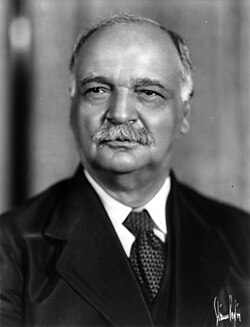
Charles Curtis
January 25, 1860 – February 8, 1936
Charles Curtis (1860-1936), an enrolled citizen of the Kaw Nation, was a Republican congressman and senator from Kansas, Senate majority leader from 1924 to 1929, and the 31st vice president of the United States under Herbert Hoover from 1929 to 1933, the first Native American to hold that office.
Biography
Charles Curtis was born in 1860 in North Topeka, Kansas Territory. His mother, who died when he was three, was of Kaw, Osage, Potawatomi and French descent, and he spent part of his childhood with his maternal grandparents on the Kaw reservation, where he became a skilled jockey in prairie horse races. He read law in a Topeka firm, was admitted to the bar in 1881 and served as prosecuting attorney of Shawnee County from 1885 to 1889.
Elected to the U.S. House of Representatives as a Republican in 1892, he served from 1893 to 1907. He backed the assimilation of Native Americans through education, and his Curtis Act of 1898 extended allotment to the Five Civilized Tribes of the Indian Territory, though he was unhappy with how the bill had been rewritten in committee. In 1907 the Kansas legislature sent him to the Senate, where he served until 1913 and again, after winning a popular vote, from 1915 to 1929.
In the Senate he was briefly president pro tempore in 1911, then Republican whip and, from 1924, majority leader, known as a party regular who could bargain across factions and kept a famous card index of constituents. He introduced the first version of the Equal Rights Amendment in the Senate in 1921.
Though he had opposed Herbert Hoover's nomination, he became Hoover's running mate in 1928, and their landslide win made him the first Native American vice president. He opened the 1932 Summer Olympics in Los Angeles, and the ticket lost to Franklin D. Roosevelt later that year. After leaving office in 1933 he practised law in Washington, where he died of a heart attack in 1936.
Offices held
2 terms
- Jan 29, 1907 – Mar 3, 1913
- Mar 4, 1915 – Mar 3, 1929
Charles G. Dawes Succeeded by
John Nance Garner
