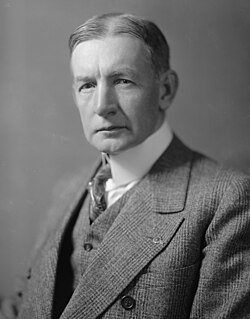
Charles G. Dawes
August 27, 1865 – April 23, 1951
Republican banker and statesman who devised the Dawes Plan on German reparations, shared the 1925 Nobel Peace Prize, and was Vice President of the United States from 1925 to 1929.
Biography
Charles Gates Dawes was born in Marietta, Ohio, in 1865, the son of the Civil War general Rufus Dawes. He graduated from Marietta College in 1884 and Cincinnati Law School in 1886, practised law in Lincoln, Nebraska, until 1894, and then moved into business as head of gas companies in Wisconsin and Illinois. A self-taught musician, he also wrote the 1912 piece Melody in A Major, which decades later became the hit song It's All in the Game.
Dawes ran the Illinois campaign for William McKinley in 1896 and was rewarded with the post of Comptroller of the Currency, which he held from 1898 to 1901. After a failed bid for the Senate he founded the Central Trust Company of Illinois and led it until 1921. In the First World War he served in France as a brigadier general in charge of purchasing for the American Expeditionary Forces, and in 1921 he became the first director of the new Bureau of the Budget.
Appointed to the Allied Reparations Commission in 1923, Dawes chaired the committee whose Dawes Plan restructured German reparations through large American loans, work for which he shared the 1925 Nobel Peace Prize. He was elected vice president on Calvin Coolidge's ticket in 1924. In office he attacked the Senate filibuster and backed the McNary-Haugen farm relief bill, which Coolidge vetoed, and the two men grew estranged.
From 1929 to 1931 Dawes was ambassador to the United Kingdom. He briefly headed the Reconstruction Finance Corporation in 1932 before resigning to rescue his Chicago bank, ending his public career. He died in Evanston, Illinois, in 1951.
Offices held
Calvin Coolidge Succeeded by
Charles Curtis
Military service
Affiliations
Party membership
Education
- Marietta College AB, graduated 1884
- University of Cincinnati College of Law Cincinnati Law School, LLB 1886

