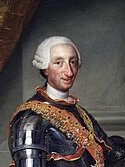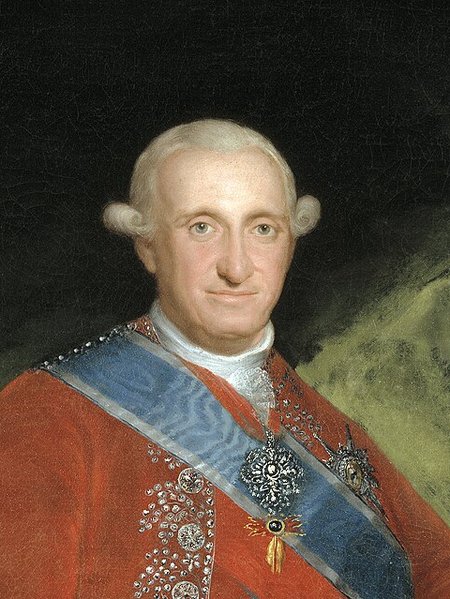
Charles IV of Spain
November 11, 1748 – January 20, 1819
King of Spain from 1788 until he abdicated in 1808, when Napoleon took control of Spain.
Biography
Charles was born in 1748 at the Palace of Portici near Naples, the second son of Charles III, then King of Naples and Sicily, and Maria Amalia of Saxony. Because his elder brother was passed over, Charles became heir to the Spanish throne. In 1765 he married his cousin Maria Luisa of Parma, with whom he had fourteen children. He was known for his love of hunting rather than for any interest in government.
He became King of Spain in December 1788. He first kept his father's minister, the Count of Floridablanca, but in 1792 power passed to Manuel Godoy, a favourite of the queen, while the king himself took only a passive part in affairs. Spain fought revolutionary France from 1793, then allied with it from 1796 against Britain, a course that brought defeat at Trafalgar and a growing need for money. A 1804 decree forcing the Church in the Americas to call in its mortgages ruined many colonial landowners. The crown also funded scientific voyages and in 1803 authorised the Balmis Expedition to vaccinate the empire's population against smallpox.
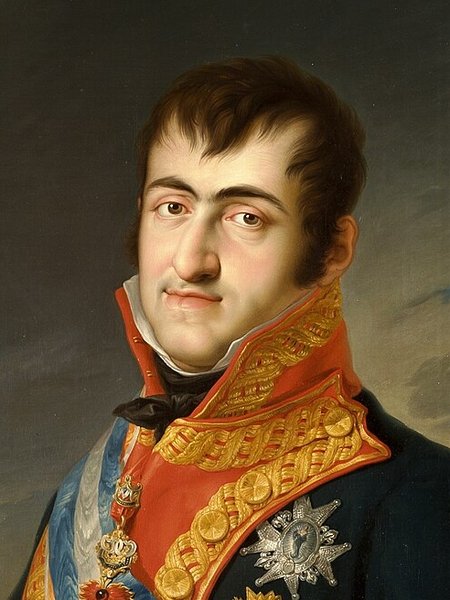
Godoy's unpopularity and rumours about the court strengthened the party of Crown Prince Ferdinand, who plotted against his father in 1807. In March 1808 the riot known as the Tumult of Aranjuez forced Charles to abdicate in Ferdinand's favour. Both were then summoned by Napoleon to Bayonne, where they gave up their rights and Napoleon placed his brother Joseph on the Spanish throne.
Charles spent his remaining years in exile, held first in France and later living in Rome. He died in Naples in January 1819, a few weeks after his wife.
Offices held
Charles III of Spain Succeeded by
Joseph Bonaparte
2 terms
- Dec 14, 1788 – Mar 19, 1808 Preceded by Charles III of Spain Succeeded by Ferdinand VII
- May 5, 1808 – May 6, 1808 Preceded by Ferdinand VII Succeeded by Joseph Bonaparte