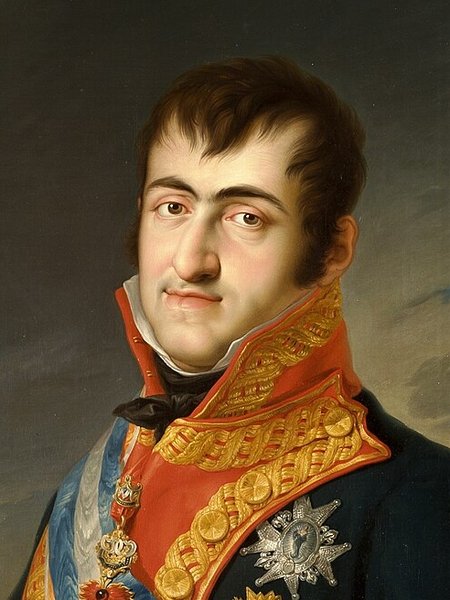
Ferdinand VII
October 14, 1784 – September 29, 1833
King of Spain in 1808 and from 1813 to 1833, whose absolutist rule saw the loss of most of Spanish America.
Biography
Ferdinand was born at El Escorial in 1784, the eldest surviving son of Charles IV and Maria Luisa of Parma. As heir he was kept out of government by his parents and their favourite, Manuel Godoy, and in 1807 he was arrested over the El Escorial conspiracy, which had sought Napoleon's backing. The Tumult of Aranjuez in March 1808 forced Charles IV to abdicate in his favour, but within weeks Napoleon made both father and son renounce the throne at Bayonne and gave it to Joseph Bonaparte.
Ferdinand spent the Peninsular War as a captive at Valençay while Spaniards fought in his name. Restored by the Treaty of Valençay in December 1813, he returned in 1814, abolished the liberal Constitution of 1812, reinstated the Inquisition and persecuted liberals and freemasons. Most of Spanish America broke away during his reign.
A military revolt led by Rafael del Riego in 1820 forced him to restore the constitution for three years, until a French army authorised by the Congress of Verona returned him to absolute power in 1823; the following 'Ominous Decade' saw renewed repression. In 1830 he issued the Pragmatic Sanction allowing women to inherit the crown, so that his daughter Isabella displaced his brother Carlos. When he died in 1833, Carlos rose in revolt and Spain fell into a civil war over the succession.
Offices held
Charles IV of Spain Succeeded by
Isabella II
2 terms
- Mar 19, 1808 – May 6, 1808 Preceded by Charles IV of Spain Succeeded by Charles IV of Spain
- Dec 11, 1813 – Sep 29, 1833 Preceded by Joseph Bonaparte Succeeded by Isabella II
Family
 Ferdinand VII
 Princess Maria Antonia of Naples and Sicily