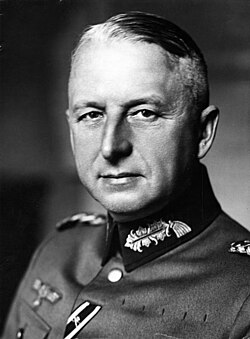
Erich von Manstein
November 24, 1887 – June 10, 1973
Erich von Manstein (1887-1973) was a German military officer who served as a field marshal (Generalfeldmarschall) in the German Army during World War II. After the war he was convicted of war crimes and sentenced to 18 years' imprisonment.
Biography
Erich von Manstein was born Erich von Lewinski in Berlin in 1887 and adopted by his mother's childless sister and her husband, General Georg von Manstein; Paul von Hindenburg was his uncle by marriage. After school in Strasbourg and the cadet corps, he was commissioned in 1906 and entered the War Academy in 1913, but the outbreak of war in 1914 cut his course short. He served as a staff officer on both fronts in the First World War.
Kept on in the small postwar Reichswehr, he held staff and command posts and in 1936 became deputy chief of the army general staff. In 1939 he was chief of staff of Army Group South in Poland, and his plan for an armoured thrust through the Ardennes was adopted for the 1940 invasion of France. In the Soviet Union his Eleventh Army took Sevastopol in 1942, and he was promoted field marshal.
He led the failed attempt to relieve Stalingrad and then the counter-offensive that retook Kharkov in early 1943, and was a main commander at Kursk. Repeated disputes with Hitler led to his dismissal in March 1944. His forces worked with the Einsatzgruppe D killing units in Crimea, and his November 1941 order called for the destruction of the 'Jewish Bolshevik system'.
Captured by the British in 1945, he testified for the general staff at Nuremberg and in 1949 was tried in Hamburg, convicted on nine of seventeen charges and sentenced to eighteen years, later reduced to twelve. Released in 1953, he advised the West German government on rebuilding the army, wrote the memoir Lost Victories, which fed the myth of a clean Wehrmacht, and died near Munich in 1973.
Military service
- Army Group South Commander
- Imperial German Army
Affiliations
Education
- Oct 1, 1913 – Aug 1, 1914 Prussian Military Academy Prussian War Academy, October 1913 until the outbreak of war in August 1914 (completed only the first year)


