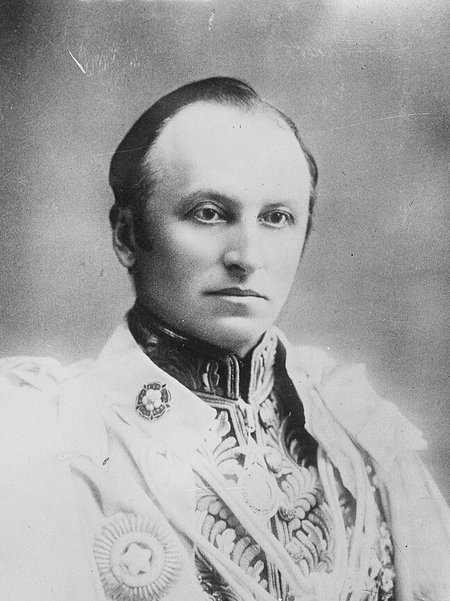
George Curzon
January 11, 1859 – March 20, 1925
Viceroy of India and British Foreign Secretary (1859–1925).
Biography
George Nathaniel Curzon was born at Kedleston Hall in Derbyshire in 1859, the eldest son of the 4th Baron Scarsdale, and was educated at Eton and at Balliol College, Oxford, where he was President of the Union; in 1883 he won a prize fellowship at All Souls. Elected Conservative MP for Southport in 1886, he travelled widely through Russia, Central Asia, Persia and East Asia and wrote books arguing that Russia threatened British India. He was Under-Secretary of State for India in 1891-1892 and for Foreign Affairs from 1895 to 1898.
Appointed Viceroy of India in January 1899, he created the North-West Frontier Province, restored the Taj Mahal, pressed for the punishment of Europeans who attacked Indians, sent a British expedition into Tibet and in 1905 carried through the partition of Bengal, which provoked the Swadeshi protest movement. A clash with Lord Kitchener over control of the army in India ended in his resignation in August 1905.
In 1907 he was elected Chancellor of Oxford University, and in 1908 he entered the House of Lords as an Irish representative peer, where he fought the Liberal plan to remove the Lords' veto. He joined Asquith's coalition as Lord Privy Seal in 1915 and headed the Air Board in 1916; under Lloyd George he sat in the War Cabinet as Leader of the House of Lords and Lord President of the Council.
As Foreign Secretary from October 1919 to January 1924 he gave his name to the proposed Curzon Line between Poland and Soviet Russia, oversaw the creation of Transjordan and led the Allied negotiators at Lausanne. He was made a marquess in 1921. Passed over for prime minister in favour of Stanley Baldwin in 1923, he returned to the cabinet as Lord President in November 1924 and died in London in March 1925.
Offices held
Victor Bruce, 9th Earl of Elgin Succeeded by
Gilbert Elliot-Murray-Kynynmound, 4th Earl of Minto

