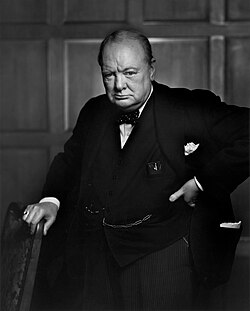
Winston Churchill
November 30, 1874 – January 24, 1965
Sir Winston Churchill (1874–1965) was a British statesman, military officer, and writer who served as Prime Minister of the United Kingdom from 1940 to 1945, during the Second World War, and again from 1951 to 1955. He was a member of Parliament for some 62 of the years between 1900 and 1964 and led the Conservative Party from 1940 to 1955 (having been a Liberal from 1904 to 1924).
Biography
Churchill was born at Blenheim Palace in 1874 into an aristocratic family. He trained at Sandhurst and was commissioned into the 4th Queen's Own Hussars in 1895. As a soldier and war correspondent he saw action on the North-West Frontier of India, in the Sudan and in the Second Boer War, where his capture and escape made him well known.
He entered the House of Commons as a Conservative in 1900, crossed to the Liberals in 1904 and held a series of cabinet posts under Asquith, including Home Secretary and First Lord of the Admiralty. The failure of the Gallipoli campaign forced him out of the Admiralty in 1915, and he served for some months on the Western Front. He returned to government under Lloyd George and, after rejoining the Conservatives, was Chancellor of the Exchequer from 1924 to 1929.
Out of office in the 1930s, he warned against German rearmament and opposed appeasement. He went back to the Admiralty when war began in 1939 and became Prime Minister in May 1940. He led Britain through the Second World War, built the alliance with the United States and the Soviet Union, and met Roosevelt and Stalin at Tehran and Yalta.
Defeated in the 1945 election, he led the opposition and warned of an "iron curtain" across Europe. He was Prime Minister again from 1951 to 1955, received the Nobel Prize in Literature in 1953 for his historical writing, and stayed an MP until 1964. He died in 1965 and received a state funeral.
Offices held
2 terms
- Oct 24, 1900 – Oct 26, 1922
- Oct 29, 1924 – Sep 25, 1964
David Lloyd George Succeeded by
John Burns
Aretas Akers-Douglas, 1st Viscount Chilston Succeeded by
Reginald McKenna
Reginald McKenna Succeeded by
A. V. Alexander, 1st Earl Alexander of Hillsborough
2 terms
- Oct 24, 1911 – May 25, 1915 Preceded by Reginald McKenna Succeeded by Arthur Balfour
- Sep 3, 1939 – May 11, 1940 Preceded by James Stanhope, 7th Earl Stanhope Succeeded by A. V. Alexander, 1st Earl Alexander of Hillsborough
Edwin Montagu Succeeded by
Herbert Samuel, 1st Viscount Samuel
Christopher Addison, 1st Viscount Addison Succeeded by
Andrew Weir, 1st Baron Inverforth
Edward Stanley, 17th Earl of Derby Succeeded by
Laming Worthington-Evans
George Curzon Succeeded by
Freddie Guest
Alfred Milner, 1st Viscount Milner Succeeded by
Victor Cavendish, 9th Duke of Devonshire
Philip Snowden, 1st Viscount Snowden Succeeded by
Philip Snowden, 1st Viscount Snowden
Neville Chamberlain Succeeded by
Anthony Eden
2 terms
- May 10, 1940 – Jul 26, 1945 Preceded by Neville Chamberlain Succeeded by Clement Attlee
- Oct 26, 1951 – Apr 5, 1955 Preceded by Clement Attlee Succeeded by Anthony Eden
Harold Macmillan
2 terms
- May 10, 1940 – Jul 26, 1945
- Oct 28, 1951 – Mar 1, 1952 Succeeded by Harold Macmillan
Also Leader of 1 other
- Conservative Party (UK) Oct 9, 1940 – Apr 6, 1955 Preceded by Neville Chamberlain
Clement Attlee Succeeded by
Clement Attlee
Military service
- Feb 20, 1895 – Jul 1, 1900 British Army 4th Queen's Own Hussars, then South African Light Horse in 1900; end date approximate
- Nov 18, 1915 – May 7, 1916 British Army Western Front: Grenadier Guards, then lieutenant-colonel commanding 6th Royal Scots Fusiliers; dates approximate
Affiliations
Party membership
- Jul 6, 1899 – May 31, 1904 Conservative Party (UK) Stood for Oldham in 1899; crossed the floor to the Liberals in 1904
- May 31, 1904 – Oct 29, 1924 Liberal Party (UK)
- from Oct 29, 1924 Conservative Party (UK) Elected as a Constitutionalist in 1924; formally rejoined the Conservatives in 1925


