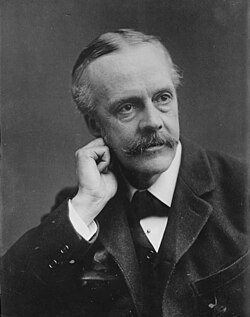
Arthur Balfour
July 25, 1848 – March 19, 1930
British Prime Minister, Conservative politician, and statesman (1848-1930)
Biography
Arthur James Balfour was born at Whittingehame, East Lothian, in 1848, a nephew of the future prime minister Lord Salisbury. He was educated at Eton and read moral sciences at Trinity College, Cambridge, and he trained as a philosopher. He entered Parliament in 1874.
Under Salisbury he was President of the Local Government Board, Secretary for Scotland and, from 1887, Chief Secretary for Ireland, where he combined firm suppression of agrarian unrest with measures against absentee landlords and earned the name 'Bloody Balfour' after the Mitchelstown shootings. From 1891 he led the Conservatives in the Commons, and in July 1902 he succeeded his uncle as prime minister. His government passed the Education Act 1902 and the Irish Land Purchase Act 1903, created the Committee of Imperial Defence and concluded the Entente Cordiale with France, but split over tariff reform; he resigned in December 1905 and lost his own seat in the 1906 landslide.
He led the opposition until 1911, then returned to office as First Lord of the Admiralty in 1915 and Foreign Secretary under Lloyd George from 1916 to 1919, when he issued the 1917 declaration supporting a Jewish national home in Palestine. He represented the British Empire at the Washington Naval Conference of 1921-22 and, as Lord President of the Council, chaired the committee that produced the Balfour Declaration of 1926 on the equal status of the Dominions. He became Earl of Balfour in 1922 and died in 1930.
Offices held
William Ewart Gladstone Succeeded by
Andrew Bonar Law
3 terms
- Aug 1, 1892 – Jun 1, 1895 Preceded by William Ewart Gladstone Succeeded by Robert Gascoyne-Cecil, 3rd Marquess of Salisbury
- Dec 5, 1905 – Feb 8, 1906 Preceded by Henry Campbell-Bannerman Succeeded by Joseph Chamberlain
- Feb 27, 1906 – Nov 13, 1911 Preceded by Joseph Chamberlain Succeeded by Andrew Bonar Law
Robert Gascoyne-Cecil, 3rd Marquess of Salisbury Succeeded by
Henry Campbell-Bannerman
Winston Churchill Succeeded by
Edward Carson
Affiliations
Education
- Jan 1, 1861 – Jan 1, 1866 Eton College
- Jan 1, 1866 – Jan 1, 1869 Trinity College, Cambridge Read moral sciences
