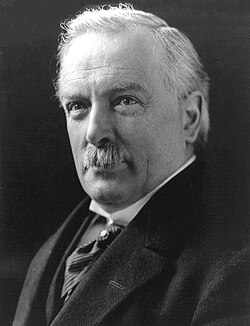
David Lloyd George
January 17, 1863 – March 26, 1945
David Lloyd George (1863–1945) was prime minister of the United Kingdom from 1916 to 1922, leading the country through the latter half of the First World War. A Welsh Liberal politician, he was known for social-reform policies, his role in the Paris Peace Conference, and negotiating the establishment of the Irish Free State.
Biography
David Lloyd George was born in Manchester in 1863 and raised in Llanystumdwy in north Wales. He qualified as a solicitor in 1884 and made his name as a radical Liberal speaker who championed Welsh causes, disestablishment of the Church in Wales and land reform. He won Caernarvon Boroughs at an 1890 by-election and held the seat for 55 years.
He joined Henry Campbell-Bannerman's cabinet in 1905 as President of the Board of Trade and became Chancellor of the Exchequer under H. H. Asquith in 1908. His 1909 People's Budget, which taxed land and high incomes to pay for welfare measures, was thrown out by the House of Lords and set off a constitutional crisis that ended with the Parliament Act 1911; the National Insurance Act of the same year helped lay the foundations of the welfare state. He was caught up in the Marconi scandal of 1913 but kept his post.
During the First World War he served as Minister of Munitions and then Secretary of State for War before replacing Asquith as prime minister in December 1916. He ran the war through a small war cabinet, introduced convoys and rationing, and led his coalition to a large victory in the 1918 election. He was a leading figure at the 1919 Paris Peace Conference and in 1921 negotiated the treaty that created the Irish Free State.
Economic depression, a scandal over the sale of honours and the Chanak Crisis weakened him, and in October 1922 the Conservatives left the coalition, forcing his resignation. He led the Liberal Party from 1926 to 1931 but never returned to office, declined a seat in Churchill's War Cabinet in 1940, and was made an earl shortly before his death in 1945.
Offices held
Charles Ritchie, 1st Baron Ritchie of Dundee Succeeded by
Winston Churchill
H. H. Asquith Succeeded by
Reginald McKenna
Herbert Kitchener, 1st Earl Kitchener Succeeded by
Edward Stanley, 17th Earl of Derby
H. H. Asquith Succeeded by
Andrew Bonar Law
H. H. Asquith Succeeded by
Herbert Samuel, 1st Viscount Samuel
Affiliations
Party membership
Family
David Lloyd George