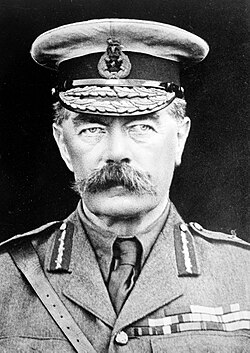
Herbert Kitchener, 1st Earl Kitchener
Irish officer and colonial administrator in the British Army (1850–1916).
Biography
Herbert Kitchener was born in 1850 near Listowel in County Kerry, the son of an army officer, and was educated in Switzerland and at the Royal Military Academy, Woolwich. As a young man he served with a French field ambulance in the Franco-Prussian War before being commissioned into the Royal Engineers in 1871. He spent the next years as a surveyor, mapping western Palestine for the Palestine Exploration Fund from 1874 to 1877 and then Cyprus, and learned Arabic.
From 1883 he helped rebuild the Egyptian Army, and in 1892 he became its commander-in-chief, or Sirdar. He led the reconquest of the Sudan, winning at Atbara and Omdurman in 1898, confronted a French expedition at Fashoda, and briefly governed the Sudan, for which he was made Baron Kitchener of Khartoum. In the Second Boer War he served as Lord Roberts's chief of staff and then as commander-in-chief, adopting farm burning and concentration camps against Boer guerrillas.
As commander-in-chief in India from 1902 to 1909 he reorganised the Indian Army and clashed with the viceroy, Lord Curzon, who resigned. He returned to Egypt as British agent and consul-general in 1911. At the outbreak of the First World War he became Secretary of State for War and, expecting a long conflict, raised a mass volunteer army, but he was blamed for the shell shortage of 1915 and lost control of munitions and strategy. He died on 5 June 1916 when HMS Hampshire, carrying him to Russia, struck a German mine off Orkney.
Offices held
H. H. Asquith Succeeded by
David Lloyd George
Military service
Affiliations
Education
- Royal Military Academy, Woolwich Royal Military Academy, Woolwich (before commission in 1871)


