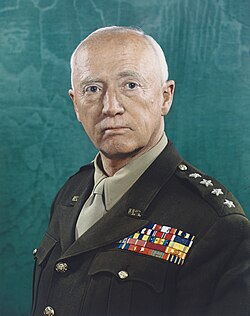
George S. Patton
November 11, 1885 – December 21, 1945
George S. Patton (1885-1945) was a general in the United States Army during World War II. He commanded the Seventh Army in the Mediterranean Theater and then the Third Army in France and Germany after the Allied invasion of Normandy in June 1944.
Biography
George Smith Patton Jr. was born in 1885 in San Gabriel, California, into a wealthy family with a military tradition. After a year at the Virginia Military Institute he entered West Point, graduating in 1909 and joining the cavalry. A keen fencer, he designed the army's M1913 cavalry saber, and he finished fifth in the modern pentathlon at the 1912 Stockholm Olympics.
He first saw combat in the 1916 Pancho Villa Expedition. In the First World War he joined the new Tank Corps, ran the American tank school in France and led tanks into battle until he was wounded. Between the wars he held staff posts and became a leading advocate of armored warfare, and when the United States entered the Second World War he commanded the 2nd Armored Division.
Patton led American troops ashore at Casablanca in Operation Torch in 1942, restored the morale of II Corps in Tunisia and commanded the Seventh Army in Sicily, reaching Messina first. His slapping of two soldiers suffering from combat stress caused a scandal and kept him from combat command for months. In 1944 he commanded the Third Army, which raced across France and relieved Bastogne during the Battle of the Bulge before advancing deep into Germany.
After the war he became military governor of Bavaria, but was removed in late 1945 over his resistance to denazification and his public remarks; he also held and voiced antisemitic views. He then briefly commanded the Fifteenth Army, and died in Heidelberg in December 1945 after a car accident.
Military service
- Jan 1, 1909 – Jan 1, 1945 United States Army
- Aug 1, 1944 – May 8, 1945 US Third Army Commander
- Seventh United States Army Commander
- II Corps (United States) Commander
Affiliations
Education
- Jan 1, 1903 – Dec 31, 1904 Virginia Military Institute Attended one year; did not graduate
- United States Army Command and General Staff College
- United States Army War College
- United States Military Academy Class of 1909


