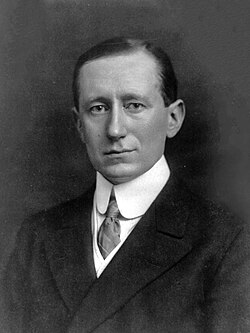
Guglielmo Marconi
April 25, 1874 – July 20, 1937
Italian inventor who developed long-distance radio telegraphy, sending the first transatlantic radio signal in 1901.
Biography
Guglielmo Marconi was born in Bologna in 1874, the son of a wealthy landowner, Giuseppe Marconi, and Annie Jameson of the Irish whiskey family. He had no formal schooling and learned science from private tutors; at eighteen the physicist Augusto Righi allowed him to attend lectures and use the laboratory and library at the University of Bologna.
Building on Heinrich Hertz's discovery of radio waves, from the mid-1890s he developed a practical system of wireless telegraphy and steadily extended its range. In 1897 he founded the Wireless Telegraph & Signal Company in Britain, later the Marconi Company. On 12 December 1901, at Signal Hill in Newfoundland, he reported hearing the Morse letter S sent from his station at Poldhu in Cornwall, and a regular transatlantic radiotelegraph service opened in 1907. He shared the 1909 Nobel Prize in Physics with Ferdinand Braun.
Marconi equipment proved its value in rescues at sea, above all in the sinking of the Titanic in 1912, after which he gave evidence to the British inquiry. Appointed to the Italian Senate in 1914, he held wireless posts in the army and navy during the First World War. He joined the National Fascist Party in 1923, became president of the National Research Council in 1927 and of the Royal Academy of Italy in 1930, and was made a marquess in 1929. In 1931 he built Vatican Radio's station for Pope Pius XI. He died in Rome in 1937.
Affiliations
Party membership
- from Jan 1, 1923 National Fascist Party

