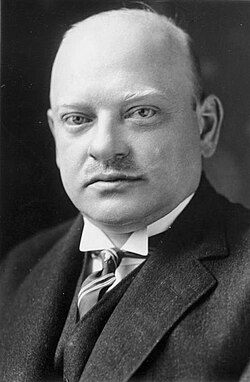
Gustav Stresemann
May 10, 1878 – October 3, 1929
German Chancellor (1923) and Foreign Minister (1923-1929); Nobel Peace Prize 1926
Biography
Gustav Stresemann was born in Berlin in 1878, the youngest child of a beer bottler and bar keeper. He studied political economy at the University of Berlin and then at Leipzig, where he earned a doctorate in 1901 with a thesis on the Berlin bottled beer trade. He went on to work for industrial trade associations in Saxony and sat on the Dresden town council.
Elected to the Reichstag for the National Liberal Party in 1907, he lost his seat in 1912, returned in 1914 and became the party's leader in 1917. During the First World War he backed annexationist war aims and unrestricted submarine warfare. After the defeat he founded the German People's Party in December 1918 and led it until his death, moving slowly from monarchism toward working within the Weimar Republic.
In August 1923 he became chancellor and foreign minister of a grand coalition. During his short chancellorship he called off passive resistance to the French and Belgian occupation of the Ruhr and introduced the Rentenmark to stop hyperinflation, before losing a confidence vote in November. He stayed on as foreign minister in every cabinet until 1929.
As foreign minister he secured the Dawes Plan, the Locarno Treaties and Germany's entry into the League of Nations, renewed ties with the Soviet Union in the Treaty of Berlin, and brought Germany into the Kellogg-Briand Pact. He shared the 1926 Nobel Peace Prize with Aristide Briand. Already in poor health, he negotiated the Young Plan and died in Berlin after a series of strokes on 3 October 1929.
Offices held
Affiliations
Education
- Apr 1, 1897 – Jan 1, 1898 Humboldt University of Berlin studied political economy (enrolled April 1897)
- Jan 1, 1898 – Jan 1, 1901 Leipzig University doctorate in economics under Karl Bücher, completed January 1901
Party membership
- Jan 1, 1907 – Jan 1, 1918 National Liberal Party (Germany)
- Jan 1, 1918 – Jan 1, 1918 German Democratic Party
- Dec 15, 1918 – Oct 3, 1929 German People's Party founder; member until his death


