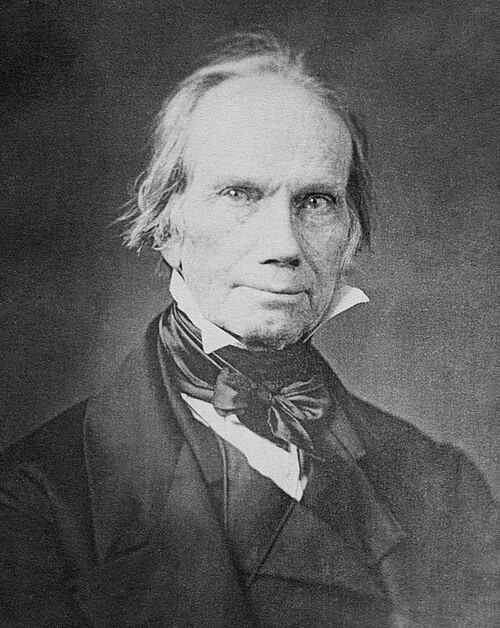
Henry Clay
April 12, 1777 – June 29, 1852
Henry Clay was an American lawyer, statesman, and diplomat who represented Kentucky in both the U.S. House of Representatives and the Senate. He was the seventh House speaker and the ninth secretary of state, and he helped found both the National Republican Party and the Whig Party. He ran unsuccessfully for president in 1824, 1832, and 1844, and was known as the 'Great Compromiser' for his role in defusing sectional crises.
Biography
Henry Clay was born in Hanover County, Virginia, in 1777, the son of a Baptist minister who died when he was four. As a teenager he worked as a clerk at the Virginia High Court of Chancery and became secretary to the judge George Wythe, under whose influence he read law; he was admitted to the bar in 1797 and moved to Lexington, Kentucky. There he built a successful practice, taught at Transylvania University, married Lucretia Hart in 1799, and developed the Ashland plantation, worked by enslaved people.
Clay entered the Kentucky House of Representatives in 1803 and twice served short unexpired terms in the US Senate. Elected to the House of Representatives in 1810, he was chosen Speaker in 1811 and, as a leading war hawk, helped push the country into the War of 1812. He was one of the American negotiators of the Treaty of Ghent in 1814, returned to the speakership, promoted his 'American System' of tariffs, a national bank and internal improvements, and in 1820 led the passage of the Missouri Compromise.
In the 1824 presidential election he finished fourth and then helped John Quincy Adams win in the House; his appointment as Adams's secretary of state led to charges of a 'corrupt bargain'. Elected to the Senate in 1831, he ran against Andrew Jackson as the National Republican candidate in 1832 and lost heavily, helped end the nullification crisis with the Tariff of 1833, and became a founder and leader of the Whig Party. He resigned from the Senate in 1842 and narrowly lost the 1844 presidential election to James K. Polk.
Clay opposed the Mexican-American War, in which his son Henry Jr. was killed. Returning to the Senate in 1849, he proposed the measures that became the Compromise of 1850, easing the sectional crisis over slavery for a time. He died in Washington in June 1852 and was the first person to lie in state in the US Capitol.
Offices held
4 terms
- Nov 19, 1806 – Mar 3, 1807
- Jan 10, 1810 – Mar 3, 1811
- Nov 10, 1831 – Mar 31, 1842
- Mar 4, 1849 – Jun 29, 1852
3 terms
- Mar 4, 1811 – Jan 19, 1814 Member of the U.S. House of Representatives from Kentucky
- Mar 4, 1815 – Mar 3, 1821 Member of the U.S. House of Representatives from Kentucky
- Mar 4, 1823 – Mar 4, 1825
John Quincy Adams Succeeded by
James Alexander Hamilton
Affiliations
Employment
- from Jan 1, 1805 Transylvania University appointed to the faculty in 1805; no end date given
