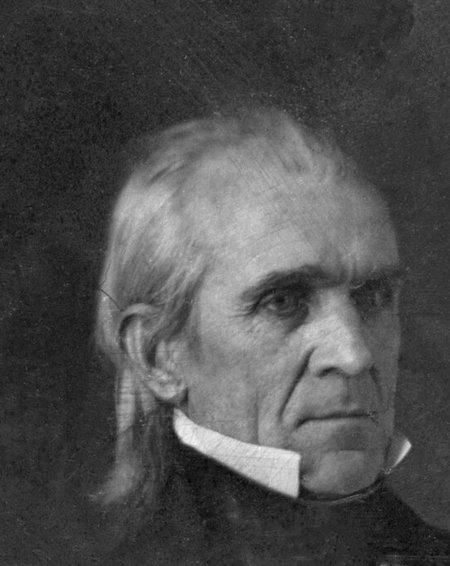
James K. Polk
November 2, 1795 – June 15, 1849
James K. Polk (1795-1849) was the 11th president of the United States, serving from 1845 to 1849. A protégé of Andrew Jackson and former Speaker of the House, he oversaw the annexation of Texas, the Oregon settlement and the Mexican–American War.
Biography
James K. Polk was born in a log cabin in Pineville, North Carolina, in 1795, and his family moved to Maury County, Tennessee, in 1806. He entered the University of North Carolina in 1816 and graduated with honors in 1818, then studied law in Nashville under Felix Grundy and built a successful practice.
Elected to the Tennessee legislature in 1823 and to the U.S. House of Representatives in 1825, he became a close ally of Andrew Jackson. He chaired the Ways and Means Committee and served as Speaker of the House from 1835 to 1839, the only Speaker who later became president. He was governor of Tennessee from 1839 to 1841 but lost the governorship in 1841 and 1843.
At the deadlocked 1844 Democratic convention he emerged as a dark-horse compromise nominee and went on to narrowly defeat Henry Clay. As president he pursued expansion: Texas joined the Union, a settlement with Britain divided the Oregon Country along the 49th parallel, and victory in the Mexican–American War brought the cession of the American Southwest. He also cut tariffs through the Walker tariff and restored the Independent Treasury.
Keeping his pledge to serve a single term, Polk left office in 1849 and died of cholera in Nashville that June. A slaveholder who enlarged his Mississippi plantation while president, he is ranked highly by many historians for achieving his goals, while his expansion sharpened the sectional conflict over slavery.
Offices held
Newton Cannon Succeeded by
James C. Jones
Affiliations
Education
- Jan 1, 1816 – May 1, 1818 University of North Carolina at Chapel Hill AB with honors

