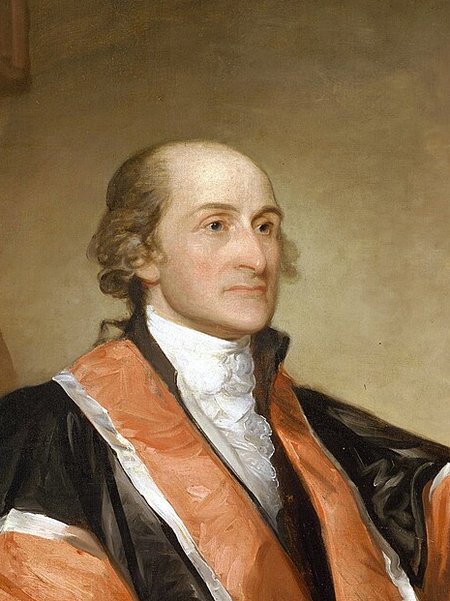
John Jay
December 23, 1745 – May 17, 1829
American Founding Father, diplomat and jurist who helped negotiate the 1783 Treaty of Paris, served as the first Chief Justice of the United States (1789-1795) and negotiated the Jay Treaty. He was later governor of New York (1795-1801).
Biography
John Jay was born in New York City in 1745 into a wealthy merchant family of Huguenot and Dutch descent and graduated from King's College (now Columbia) in 1764. Admitted to the bar in 1768, he became secretary of New York's committee of correspondence in 1774 and represented New York at the First and Second Continental Congresses; he was president of the Congress from December 1778 to September 1779.
Jay then went to Spain as minister, seeking money and recognition with limited success, and helped negotiate and signed the 1783 Treaty of Paris that ended the Revolutionary War. As secretary of foreign affairs from 1784 to 1789 he directed the young country's diplomacy, and he co-wrote The Federalist Papers with Alexander Hamilton and James Madison in support of the new Constitution.
Washington appointed him the first Chief Justice of the United States in 1789; his court decided Chisholm v. Georgia. In 1794 he negotiated the Jay Treaty with Britain, which averted war but proved deeply unpopular. Elected governor of New York in 1795 after narrowly losing in 1792, he served two terms; he was a founder of the New York Manumission Society, though he himself owned slaves into the 1800s. He retired to Bedford in 1801, later led the American Bible Society, and died in 1829.
Offices held
Henry Laurens
George Clinton Succeeded by
George Clinton
Affiliations
Education
- Jan 1, 1760 – Jan 1, 1764 Columbia University King's College (now Columbia); BA 1764, MA 1767

