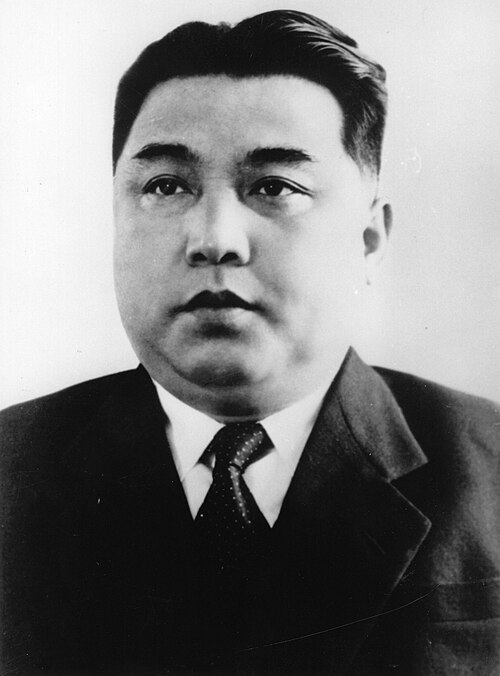
Kim Il-sung
Kim Il-sung (1912–1994) was a North Korean communist revolutionary who founded the Democratic People's Republic of Korea in 1948 and led it until his death in 1994, more than 45 years in office. He was succeeded by his son Kim Jong Il and was posthumously declared Eternal President.
Biography
Kim Il-sung was born Kim Song-ju in 1912 near Pyongyang, then under Japanese rule, and grew up mostly in Manchuria after his family left Korea in 1919. As a teenager he turned to communism, was jailed for several months in 1929, and in 1931 joined the Chinese Communist Party. Through the 1930s he fought with Communist-led anti-Japanese guerrilla units in Manchuria, rising to command a division and leading a 1937 raid on Pochonbo that made his name. Hunted by Japanese forces, he crossed into the Soviet Union in 1940 and served as a captain in the Red Army's 88th Separate Rifle Brigade until 1945.
Returning to Korea after Japan's surrender, Kim was backed by the Soviet occupation authorities, who put him at the head of the northern Communist party bureau and, in February 1946, of the Provisional People's Committee. When the Democratic People's Republic of Korea was proclaimed in 1948 he became its premier, and in 1949 chairman of the newly merged Workers' Party of Korea. He launched the invasion of the South in June 1950; the Korean War ended in a 1953 armistice that left the peninsula divided.
After the war Kim rebuilt the North as a centrally planned state geared to heavy industry and arms production, eliminated rival factions, notably in the 1956 August faction incident, and promoted the Juche doctrine of self-reliance alongside an intense personality cult. A new constitution in 1972 made him president, and in 1980 he publicly designated his son Kim Jong Il as successor.
The loss of Soviet aid after 1991 sent the economy into collapse. In June 1994, after a visit by Jimmy Carter, Kim agreed to halt North Korea's nuclear programme; he died of a heart attack the following month and was later proclaimed the country's Eternal President.
Offices held
Kim Jong-il
Kim Jong-il
Military service
- Jul 17, 1942 – Jan 1, 1945 Red Army
- Korean People's Army
Affiliations
Party membership
- from Jan 1, 1932 Communist Party of China
- from Oct 10, 1945 Workers' Party Of Korea