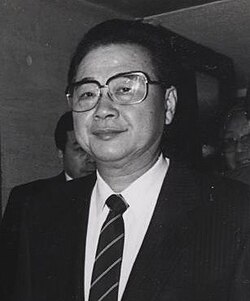
Li Peng
October 20, 1928 – July 22, 2019
Li Peng (1928–2019) was a Chinese politician who served as Premier of China from 1987 to 1998 and as chairman of the Standing Committee of the National People's Congress from 1998 to 2003. For much of the 1990s he ranked second in the Chinese Communist Party hierarchy behind General Secretary Jiang Zemin, retaining his Politburo Standing Committee seat until his retirement in 2002.
Biography
Li Peng was a Chinese Communist politician who was premier from 1987 to 1998 and chairman of the National People's Congress from 1998 to 2003. Born in Shanghai in 1928, he was the son of an early Communist revolutionary executed by the Kuomintang in 1931 and grew up under the patronage of Zhou Enlai, who sent him to Yan'an in 1941. He joined the party in 1945.
Trained as a hydroelectric engineer at the Moscow Power Engineering Institute, he returned to China in 1955 and spent two decades in the power industry, running power plants and the Beijing power bureau and leading power restoration after the 1976 Tangshan earthquake. He rose with Deng Xiaoping's reforms to become minister of power, a vice premier and in 1987 a member of the Politburo Standing Committee.
As premier during the 1989 Tiananmen Square protests, Li backed a hard line and declared martial law in Beijing on 20 May, days before the army crushed the demonstrations. He launched the Three Gorges Dam project in 1994 and preparations for China's crewed space programme. After his second term as premier he chaired the National People's Congress until 2003. He died in 2019.
Offices held
Zhao Ziyang Succeeded by
Zhu Rongji
Affiliations
Education
- Jan 1, 1941 – Jan 1, 1945 Beijing Institute of Technology Yan'an Institute of Natural Science, a predecessor of the Beijing Institute of Technology
- Jan 1, 1948 – Jan 1, 1954 Moscow Power Engineering Institute Hydroelectric engineering, Moscow Power Engineering Institute
Party membership
- from Jan 1, 1945 Communist Party of China


