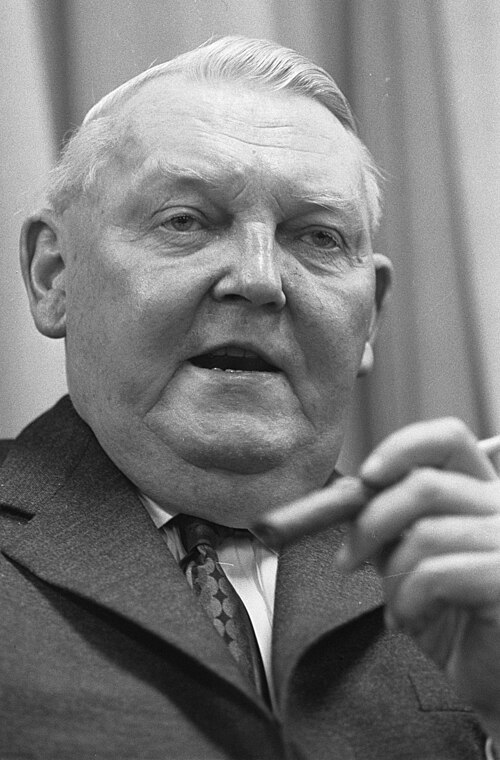
Ludwig Erhard
February 4, 1897 – May 5, 1977
German economist and Christian Democratic politician who, as economics minister from 1949 to 1963, led West Germany's postwar recovery under the banner of the social market economy, and was chancellor from 1963 to 1966.
Biography
Ludwig Erhard was born in Fürth in 1897. He volunteered for the German army in 1916 and served as an artilleryman on the Western Front and in Romania until a shell wounded him badly near Ypres in September 1918. Unable to return to the drapery trade, he studied business in Nuremberg and then economics at Goethe University Frankfurt under Franz Oppenheimer, earning a doctorate in 1925.
From 1928 he worked at a market research institute, rising to deputy director, until he lost the post in 1942; during the war he wrote a study on postwar debt that assumed Germany's defeat. After 1945 he advised the occupation authorities, led the expert office that prepared the 1948 currency reform, and as economics director of the Bizone scrapped price controls when the Deutsche Mark was introduced in June 1948.
Elected to the first Bundestag for the Christian Democrats in 1949, he was federal economics minister under Konrad Adenauer for fourteen years and vice-chancellor from 1957. His liberal policies, which he called the social market economy, became identified with West Germany's rapid postwar recovery, the Wirtschaftswunder.
Erhard succeeded Adenauer as chancellor in October 1963 and won the 1965 election, but lacked Adenauer's backing and lost support over a budget deficit and foreign policy. After the Free Democrats left his coalition he resigned in November 1966. He kept his Bundestag seat until his death in Bonn in 1977.
Offices held
Konrad Adenauer Succeeded by
Kurt Georg Kiesinger
Affiliations
Education
- Jan 1, 1922 – Dec 12, 1925 Goethe University Frankfurt Doctorate in economics under Franz Oppenheimer, Goethe University Frankfurt
