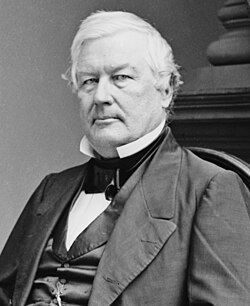
Millard Fillmore
January 7, 1800 – March 8, 1874
Millard Fillmore (1800-1874) was the 13th president of the United States, serving from 1850 to 1853 after the death of Zachary Taylor. The last Whig president, he was instrumental in passing the Compromise of 1850.
Biography
Millard Fillmore was born into poverty in the Finger Lakes region of New York in 1800. With little formal schooling he studied law and became a prominent attorney in Buffalo. He entered politics through the Anti-Masonic Party, was elected to the New York Assembly in 1828 and to the U.S. House in 1832, and joined the Whig Party as it formed in the mid-1830s.
In the House he chaired the Ways and Means Committee from 1841 to 1843. After losing the 1844 race for governor of New York he was elected state comptroller in 1847, the first to win that office by popular vote, and in 1848 he was elected vice president on the Whig ticket with Zachary Taylor. Presiding over the Senate, he oversaw its bitter debates over slavery in the lands taken from Mexico.
Fillmore became president when Taylor died in July 1850. He replaced Taylor's cabinet and pushed Congress to pass the Compromise of 1850, including the Fugitive Slave Act, which he enforced although it hurt him and the Whigs in the North. He and Secretary of State Daniel Webster sent Commodore Matthew Perry on the expedition to open Japan to trade, and he warned France against annexing Hawaii. The Whigs did not renominate him in 1852.
As the Whig Party collapsed he joined the Know Nothings and ran for president in 1856 as the American Party candidate, losing to James Buchanan. He had helped found the University of Buffalo in 1846 and served as its chancellor until his death in 1874.
Offices held
2 terms
- Mar 4, 1833 – Mar 3, 1835
- Mar 4, 1837 – Mar 3, 1843
George M. Dallas Succeeded by
William R. King
Zachary Taylor Succeeded by
Franklin Pierce
Affiliations
Party membership
- Whig Party (United States)
- Know Nothing
- Anti-Masonic Party Early career, before joining the Whigs
