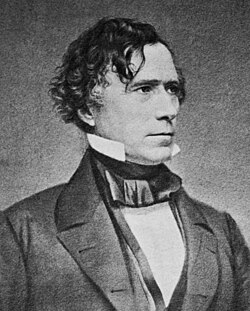
Franklin Pierce
November 23, 1804 – October 8, 1869
14th president of the United States (1853-1857), a northern Democrat whose support for the Kansas-Nebraska Act and enforcement of the Fugitive Slave Act alienated anti-slavery Northerners.
Biography
Franklin Pierce was born in 1804 in Hillsborough, New Hampshire, the son of Benjamin Pierce, a Revolutionary War veteran who later became the state's governor. After Phillips Exeter Academy he graduated from Bowdoin College in 1824, where Nathaniel Hawthorne became a lifelong friend, and he was admitted to the bar in 1827.
Pierce rose quickly in New Hampshire's Democratic Party. He entered the state House of Representatives in 1829 and was its Speaker from 1831, went to the U.S. House in 1833 and to the Senate in 1837, and resigned in 1842 to practise law in Concord. President Polk made him U.S. attorney for New Hampshire, and in the Mexican-American War he served as a brigadier general.
In 1852 a deadlocked Democratic convention chose him on the 49th ballot as a compromise candidate, and he defeated the Whig Winfield Scott easily. Shortly before his inauguration his last surviving son was killed in a train accident. As president he backed the expansionist Young America programme, approved the Gadsden Purchase, and saw his diplomats' Ostend Manifesto on Cuba denounced in the North. His support for the Kansas-Nebraska Act and strict enforcement of the Fugitive Slave Act cost him Northern support, and violence in Kansas followed.
The Democrats passed him over for renomination in 1856. In retirement he opposed Lincoln's war policies, which further hurt his reputation in the North. He died of cirrhosis in Concord in 1869 and is generally ranked among the weakest U.S. presidents.
Offices held
Millard Fillmore Succeeded by
James Buchanan
Affiliations
Education
- Jan 1, 1820 – Jan 1, 1824 Bowdoin College BA 1824
- Phillips Exeter Academy

