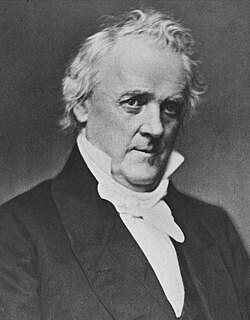
James Buchanan
James Buchanan (1791-1868) was the 15th president of the United States, serving from 1857 to 1861, and seven Southern states seceded in his final months in office. He had earlier been secretary of state, minister to Britain and a senator from Pennsylvania.
Biography
James Buchanan was born in Pennsylvania in 1791. He graduated with honors from Dickinson College in 1809, trained as a lawyer in Lancaster and passed the bar in 1812. Entering politics as a Federalist, he was elected to the Pennsylvania House of Representatives in 1814, and from 1821 to 1831 he served five terms in the U.S. House, by then aligned with Andrew Jackson's Democrats.
Jackson appointed him minister to Russia in 1832. He sat in the U.S. Senate from 1834 to 1845, chairing the Foreign Relations Committee, and was secretary of state under James K. Polk from 1845 to 1849. As minister to Britain under Franklin Pierce from 1853 to 1856 he joined in drafting the Ostend Manifesto, which argued for acquiring Cuba from Spain.
Buchanan won the presidency in 1856. Before taking office he lobbied the Supreme Court toward its pro-slavery ruling in Dred Scott v. Sandford, and as president he supported admitting Kansas as a slave state under the Lecompton Constitution, which split his party. After Abraham Lincoln's election in 1860 seven Southern states seceded in Buchanan's last months, and apart from an unsuccessful attempt to reinforce Fort Sumter he did little to prepare the military.
Having pledged to serve one term, he retired to his Lancaster estate, Wheatland, in 1861 and spent his remaining years defending his record. He died in 1868 and is generally ranked among the worst presidents.
Offices held
John C. Calhoun Succeeded by
John M. Clayton
Franklin Pierce Succeeded by
Abraham Lincoln
Affiliations
Party membership
- Democratic Party (United States)
- Federalist Party Federalist early in his career
Education
- Dickinson College Graduated with honors


