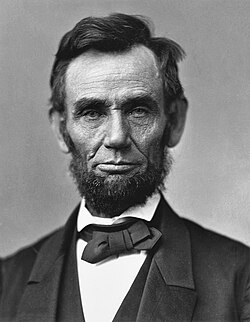
Abraham Lincoln
February 12, 1809 – April 15, 1865
Abraham Lincoln (1809–1865) was the 16th president of the United States, serving from 1861 until his assassination in 1865. He led the United States through the Civil War, defeating the Confederacy, and played a major role in the abolition of slavery. A self-educated Illinois lawyer, he became a leader of the new Republican Party after the 1854 Kansas–Nebraska Act and gained national prominence in the 1858 Senate debates against Stephen A. Douglas.
Biography
Abraham Lincoln was born in a log cabin in Kentucky in 1809 and grew up on the frontier in Indiana and Illinois with little formal schooling. He taught himself law, became a successful lawyer in Springfield, and served in the Illinois legislature and for one term in the US House of Representatives as a Whig.
The fight over the spread of slavery into the western territories brought him back into politics in the 1850s as a Republican. His debates with Stephen Douglas in 1858 made him a national figure, and in 1860 he was elected president. Before he took office seven Southern states seceded, and the Civil War began at Fort Sumter in April 1861.
As wartime president he held the Union together, searched for generals who could win, and turned the war into a struggle against slavery with the Emancipation Proclamation of 1863 and his push for the Thirteenth Amendment. His Gettysburg Address restated the war's purpose in terms of equality and democracy. He was re-elected in 1864 and was shot by John Wilkes Booth on 14 April 1865, days after Lee's surrender, and died the next morning.
Offices held
James Buchanan Succeeded by
Andrew Johnson
Affiliations
Party membership
- Jan 1, 1834 – Jan 1, 1854 Whig Party (United States)
- Jan 1, 1854 – Jan 1, 1865 Republican Party (United States)
- Jan 1, 1864 – Jan 1, 1865 National Union Party (United States)
Family
Abraham Lincoln