Napoleon
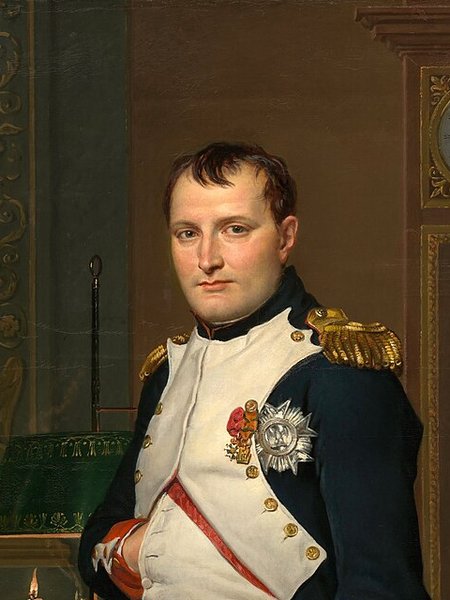
French general who seized power in 1799 and ruled as Emperor of the French from 1804 to 1814 and in 1815. His wars redrew the map of Europe until his defeat at Waterloo.
Biography
Napoleon Bonaparte was born in Ajaccio, Corsica, in 1769, a year after France acquired the island. He trained as an artillery officer and rose fast during the French Revolution: he made his name at the siege of Toulon in 1793, crushed a royalist rising in Paris in 1795, and won a string of victories over Austria in northern Italy in 1796–97. His expedition to Egypt in 1798 brought him fame, though the fleet that carried it was destroyed by Nelson on the Nile.
In November 1799 he took power in the coup of 18 Brumaire and ruled as First Consul. He reorganised the state, made peace with the Catholic Church and issued the Civil Code, which spread across much of Europe. In 1804 he crowned himself Emperor of the French. His Grande Armée beat Austria and Russia at Austerlitz in 1805, Prussia at Jena in 1806 and Russia at Friedland in 1807, and he redrew the map of Germany, Italy and Poland under French control.
Britain stayed at war and kept command of the sea after Trafalgar. The war in Spain from 1808 drained French strength, and the invasion of Russia in 1812 destroyed the Grande Armée. Defeated at Leipzig in 1813, he abdicated in April 1814 and was sent to Elba. He returned in March 1815 for the Hundred Days, was beaten at Waterloo, and spent his last years as a British prisoner on Saint Helena, where he died in 1821.
Offices held
Louis XVI Succeeded by
Louis XVIII
2 terms
- May 18, 1804 – Apr 6, 1814 Preceded by Louis XVI Succeeded by Louis XVIII
- Mar 20, 1815 – Jun 22, 1815 Preceded by Louis XVIII Succeeded by Louis XVIII
Military service
- Grande Armée Commander
Affiliations
Education
- from Jan 1, 1784 École Militaire