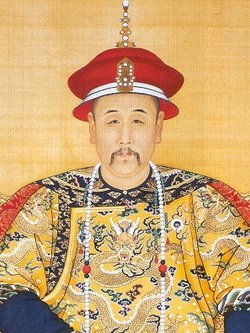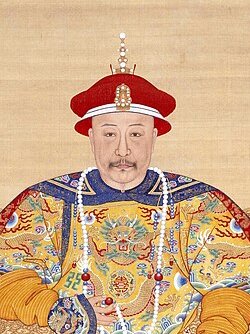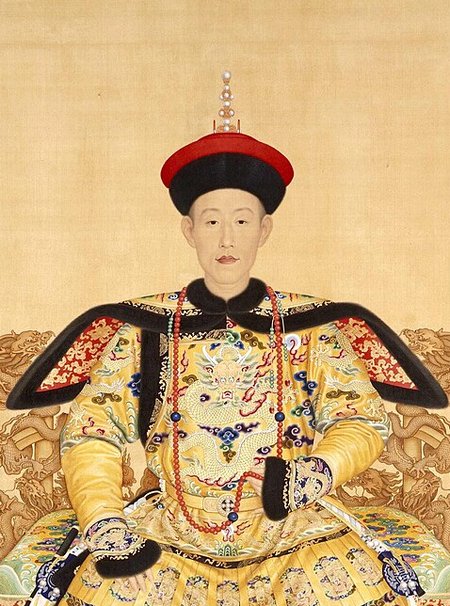
Qianlong Emperor
September 25, 1711 – February 7, 1799
Fifth emperor of the Qing dynasty (r. 1735-1796), whose campaigns doubled Qing territory and who kept ruling as Emperor Emeritus after his abdication until his death in 1799.
Biography
Hongli was born in 1711, the fourth son of the Yongzheng Emperor, and was a favourite of both his father and his grandfather, the Kangxi Emperor. After his father's accession he was made Prince Bao of the First Rank, went on inspection tours and acted as regent when the emperor was away. On Yongzheng's sudden death in 1735 a sealed succession decree named him heir, and he took the era name Qianlong.
His reign was marked by repeated military expansion. Through the Ten Great Campaigns the Qing state roughly doubled the territory of the former Ming, conquering the Dzungar Khanate and the Tarim Basin, which were joined as Xinjiang; he ordered the extermination of the Dzungars, and the destruction of the Jinchuan people followed in 1776. Further campaigns reached Burma, Nepal and Vietnam, with mixed results.
At home he was a major patron of the arts and a prolific poet, a collector who drew many private collections into the imperial holdings, and the sponsor of the Siku Quanshu compilation, which was accompanied by a literary inquisition that banned or destroyed some 3,100 works. In 1757 he confined European trade to Guangzhou, and in 1793 he received the British embassy of Lord Macartney without granting its requests.
In his later years he left much of the government to the corrupt minister Heshen, and the costs of war, building and court life drained the treasury. In 1796, unwilling to reign longer than his grandfather, he abdicated in favour of his son, the Jiaqing Emperor, but kept real power as Emperor Emeritus until his death in 1799.
Offices held
Yongzheng Emperor Succeeded by
Jiaqing Emperor