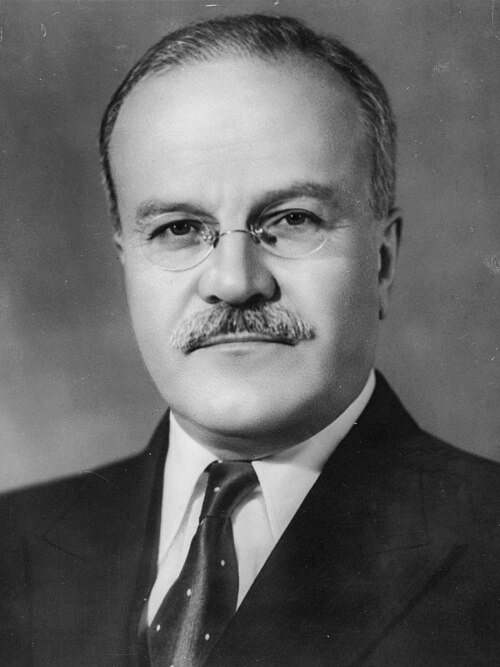
Vyacheslav Molotov
March 9, 1890 – November 8, 1986
Soviet politician and foreign minister (1939-1949); Soviet signatory of the Molotov-Ribbentrop Pact.
Biography
Vyacheslav Molotov was born Vyacheslav Skryabin in Kukarka in 1890. He joined the Russian Social Democratic Labour Party in 1906 and was arrested and exiled twice before 1917. He worked on the Bolshevik newspaper Pravda, where he first met Stalin, and in 1917 sat on the Military Revolutionary Committee that planned the October Revolution.
He headed the party Secretariat in 1921-22 and became one of Stalin's closest allies, joining the Politburo in 1926. As chairman of the Council of People's Commissars from 1930 to 1941 he oversaw forced collectivisation and the famine that followed, and he took part in the Great Purge.
Appointed foreign minister in 1939, he signed the Molotov-Ribbentrop Pact with Nazi Germany. During the Second World War he was deputy chairman of the State Defence Committee and Stalin's chief negotiator with the Allies, accompanying Stalin to Tehran, Yalta and Potsdam and representing the Soviet Union at the San Francisco Conference that created the United Nations. He lost the foreign ministry in 1949 and returned to it after Stalin's death in 1953.
His resistance to Khrushchev's de-Stalinisation led him into the Anti-Party Group's failed attempt to remove Khrushchev in 1957. He was stripped of his posts, sent to Mongolia as ambassador, and expelled from the party in 1961. He defended Stalin's legacy until his death in Moscow in 1986.
Offices held
Alexei Rykov Succeeded by
Joseph Stalin
Affiliations
Party membership
- Jan 1, 1906 – Jan 1, 1917 Russian Social Democratic Labour Party
- Mar 8, 1918 – Jan 1, 1962 Communist Party of the Soviet Union
- Jan 1, 1984 – Nov 8, 1986 Communist Party of the Soviet Union


