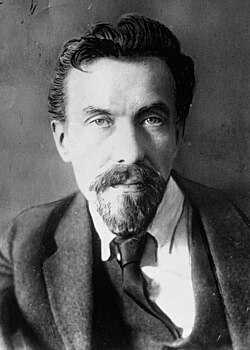
Alexei Rykov
February 25, 1881 – March 15, 1938
Bolshevik leader; head of the Soviet government 1924-1930, shot in 1938
Biography
Alexei Rykov was born in Saratov in 1881 to a family of peasant origin. He joined the Russian Social Democratic Labour Party in 1898, while still at school, and briefly studied law at Kazan University. After the 1903 split he sided with the Bolsheviks, worked as a party agent in Moscow and St Petersburg, took part in the 1905 revolution, and was elected to the party's Central Committee in 1905. He spent years in exile, in France and later in Siberia.
Back after the February Revolution, he sat in the Petrograd and Moscow Soviets and on the Moscow Military Revolutionary Committee in October 1917, and became the first People's Commissar for Internal Affairs. Within days he resigned over Lenin's refusal to share power with other socialists. From 1918 he chaired the Supreme Council of the National Economy, running war communism during the Civil War, and in 1922 he joined the Politburo.
After Lenin's death in 1924 he became chairman of the Council of People's Commissars of both the Soviet Union and the Russian republic. With Bukharin and Tomsky he led the moderates who defended the New Economic Policy, and once Stalin turned against them as the "Right Opposition" in 1928–29 he lost his posts, being replaced as Soviet premier by Molotov in December 1930.
He served as People's Commissar of Posts and later Communications until 1936. Arrested with Bukharin in February 1937, he was a defendant at the Trial of the Twenty-One in March 1938, convicted of treason and shot. The Soviet authorities annulled the verdict and rehabilitated him in 1988.
Offices held
Vladimir Lenin Succeeded by
Vyacheslav Molotov
Affiliations
Party membership
Education
- Jan 1, 1900 – Jan 1, 1901 Kazan Federal University Law studies at Kazan University, not completed

