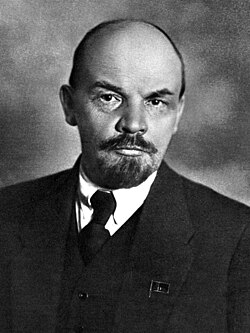
Vladimir Lenin
April 22, 1870 – January 21, 1924
Vladimir Ilyich Lenin (1870–1924) was a Russian revolutionary, politician, and political theorist who served as the first head of government of Soviet Russia from 1917 to 1924 and of the Soviet Union from 1922 to 1924. Ideologically a Marxist, his developments of the ideology are called Leninism. Born in Simbirsk, he became a revolutionary socialist after his brother's 1887 execution, was exiled to Siberia in 1897 for sedition, and returned from European exile to lead the 1917 October Revolution.
Biography
Vladimir Ilyich Ulyanov, known as Lenin, was born in Simbirsk on the Volga in 1870. The execution of his elder brother for plotting against Alexander III in 1887 pushed him towards revolution. He became a Marxist, was exiled to Siberia, and from 1900 lived mostly abroad, where he led the Bolshevik faction of the Russian Social Democratic Labour Party and argued for a disciplined party of professional revolutionaries.
After the February Revolution of 1917 the Germans let him travel back to Russia. He called for an end to the war and all power to the soviets, and in October (November by the new calendar) the Bolsheviks overthrew the Provisional Government. As head of the new Soviet government he made peace with Germany at Brest-Litovsk, dissolved the elected Constituent Assembly and led the Bolsheviks through the Civil War, using the Cheka and the Red Terror against opponents.
To revive the ruined economy he allowed limited private trade under the New Economic Policy in 1921, and in 1922 the Soviet Union was formed. Strokes removed him from active politics in 1922–23, and he died in January 1924. His body was put on display in a mausoleum in Red Square, and the struggle to succeed him was won by Stalin.
Offices held
Alexei Rykov
Affiliations
Party membership
- Aug 1, 1903 – Jan 21, 1924 Bolsheviks Bolshevik faction of the RSDLP from the 1903 split
- Jan 1, 1918 – Jan 1, 1924 Communist Party of the Soviet Union
- Russian Social Democratic Labour Party


