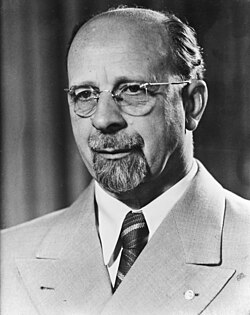
Walter Ulbricht
June 30, 1893 – August 1, 1973
Leader of the Socialist Unity Party who ruled East Germany from 1950 to 1971 and had the Berlin Wall built in 1961.
Biography
Walter Ulbricht was born in Leipzig on 30 June 1893. He joined the Social Democratic Party in 1912 and the anti-war Independent Social Democrats in 1917, deserted from the army in 1918 and took part in the German Revolution. He joined the Communist Party of Germany in 1920 and sat on its Central Committee from 1923, serving in the Saxon Landtag and from 1928 in the Reichstag.
After the Nazis took power in 1933, and facing investigation over the 1931 killing of two Berlin police captains, he lived in exile in Paris and Prague and from 1937 in the Soviet Union. He returned with the Red Army in 1945 to rebuild the Communist Party in the Soviet zone along Stalinist lines and played a central part in the forced merger of the Communists and Social Democrats into the Socialist Unity Party (SED) in 1946.
When the German Democratic Republic was founded in 1949 he became first deputy prime minister, and from 1950 he led the SED as its general secretary, later first secretary, making him the country's chief decision-maker. Soviet troops crushed the June 1953 uprising against his government. Mass emigration to the West led him to have the Berlin Wall built in August 1961, with Soviet consent.
Ulbricht also became head of state as chairman of the Council of State on Wilhelm Pieck's death in 1960. After the failure of his economic reforms of the 1960s he was replaced as party leader by Erich Honecker in 1971 with Soviet backing, though he remained head of state until he died on 1 August 1973.
Offices held
Affiliations
Party membership
- Jan 1, 1912 – Jan 1, 1917 Social Democratic Party of Germany
- Jan 1, 1917 – Jan 1, 1920 Independent Social Democratic Party of Germany
- Jan 1, 1920 – Jan 1, 1946 Communist Party of Germany
- Jan 1, 1946 – Jan 1, 1973 Socialist Unity Party of Germany


