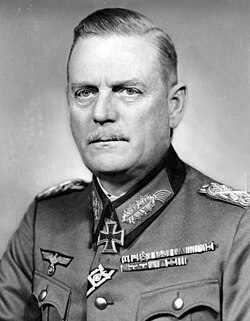
Wilhelm Keitel
September 22, 1882 – October 16, 1946
German field marshal who headed the Armed Forces High Command (OKW) from 1938 to 1945 and was hanged in 1946 after his conviction at Nuremberg.
Biography
Wilhelm Keitel was born in 1882 at Helmscherode in the Duchy of Brunswick, the son of a landowner, and joined a Prussian field artillery regiment as an officer cadet in 1901. In the First World War he was badly wounded in Flanders and then served as a staff officer. Retained in the small Reichswehr, he worked in the disguised general staff and from 1929 headed the organisation department of the war ministry, taking part in secret rearmament.
In 1935 he became chief of the Armed Forces Office in the Reich War Ministry. When Hitler took personal command of the armed forces in February 1938 after the Blomberg-Fritsch affair, Keitel became chief of the new Armed Forces High Command (OKW), with cabinet rank but little independent authority; colleagues regarded him as Hitler's compliant mouthpiece. He conducted the armistice negotiations with France in 1940 and was promoted to field marshal that July.
Keitel signed many of the regime's criminal orders, including directives for the war against the Soviet Union, the Night and Fog decree of December 1941 and the Commando Order of October 1942, and endorsed the army's role in the deportation of Jews. After the 20 July plot of 1944 he sat on the army court of honour that handed officers over to the People's Court. On 8 May 1945 he signed the German Instrument of Surrender in Berlin-Karlshorst.
Arrested on 13 May 1945, he was tried by the International Military Tribunal at Nuremberg, where his defence of obeying orders was rejected. Convicted on all four counts, he was hanged on 16 October 1946.
Affiliations
Party membership
- from Mar 1, 1939 Nazi Party


