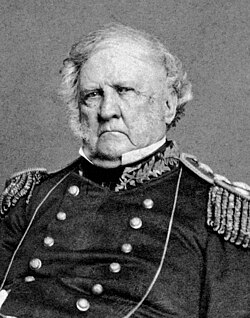
Winfield Scott
American general who commanded the US Army from 1841 to 1861, captured Mexico City in 1847, and was the Whig presidential nominee in 1852.
Biography
Winfield Scott was born in 1786 near Petersburg, Virginia. He briefly attended the College of William & Mary and practised law before taking a commission in the army in 1808. A court-martial suspended him for a year in 1810 for criticising his commanding general, but in the War of 1812 he rose quickly, distinguishing himself at Chippawa and being badly wounded at Lundy's Lane in 1814.
In the following decades he served as a general and frontier negotiator. He concluded the treaty that followed the Black Hawk War in 1832, was sent to South Carolina during the Nullification Crisis, led operations against the Seminole and Creek in 1836, and in 1838 commanded the forced removal of the Cherokee. He also calmed border tensions with British Canada during the Patriot War and the Aroostook dispute.
Scott became commanding general of the United States Army in 1841. In the Mexican-American War he landed at Veracruz in March 1847 and marched inland to take Mexico City in September, the decisive campaign of the war. A Whig, he sought the party's presidential nomination several times and won it in 1852, but lost heavily to Franklin Pierce. Congress made him a brevet lieutenant general in 1855, and in 1859 he defused the Pig War dispute with Britain over the San Juan Islands.
At the outbreak of the Civil War he organised security for Abraham Lincoln's inauguration and proposed the Anaconda Plan, a blockade and river strategy to strangle the Confederacy. Old and in poor health, he retired in November 1861 and died at West Point in 1866.
Offices held
George B. McClellan
Military service
Affiliations
Education
- from Jan 1, 1805 College of William & Mary attended briefly, then read law


