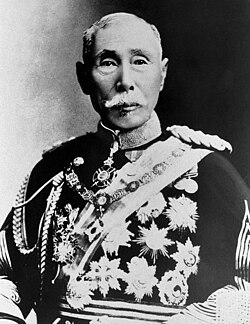
Yamagata Aritomo
June 14, 1838 – February 1, 1922
Japanese military leader and statesman (1838–1922)
Biography
Yamagata Aritomo was a Japanese soldier and statesman who built the modern Imperial Japanese Army and twice served as prime minister. Born in 1838 in Hagi, in the Chōshū domain, to a poor family of low-ranking samurai, he was drawn into the loyalist movement against the Tokugawa shogunate and fought in the wars of the Meiji Restoration.
After studying military systems in Europe, he became the central figure in creating a conscript national army on the Prussian model, and led it against the Satsuma Rebellion in 1877. He served as the army's first chief of staff, issued the Imperial Rescript to Soldiers and Sailors in 1882, and as home minister reorganised local government and the police.
Yamagata was prime minister in 1889–1891, when the Imperial Rescript on Education was issued, and again in 1898–1900. As a leading genrō and longtime president of the Privy Council, he remained one of the most powerful men in Japan into the 1910s, influencing the choice of prime ministers and the Taishō political crisis of 1912–1913. He died in 1922.
Offices held
Sanjō Sanetomi Succeeded by
Itō Hirobumi
2 terms
- Dec 24, 1889 – May 6, 1891 Preceded by Sanjō Sanetomi Succeeded by Matsukata Masayoshi
- Nov 8, 1898 – Oct 19, 1900 Preceded by Ōkuma Shigenobu Succeeded by Itō Hirobumi


