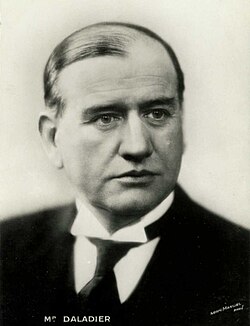
Édouard Daladier
June 18, 1884 – October 10, 1970
French Prime Minister who signed the 1938 Munich Agreement and led France into World War II in 1939.
Biography
Édouard Daladier was born in Carpentras in 1884, the son of a baker. Educated in Lyon, he taught history at lycées and universities, including the Lycée Condorcet in Paris, and became mayor of Carpentras in 1912. In the First World War he fought at Verdun, was commissioned in the field and ended the war as a captain with the Legion of Honour and the Croix de Guerre.
Elected deputy for Vaucluse in 1919, he became the leading figure of the Radical Party's left wing and held ministries in the coalition governments of the 1920s. He was briefly prime minister in 1933 and again in January 1934, when his government fell after the riots of 6 February. He then brought the Radicals into the Popular Front and served as minister of national defence from 1936.
Prime minister again from April 1938, he signed the Munich Agreement with Chamberlain, Hitler and Mussolini, then pressed rearmament, banned the Communist Party after the Nazi-Soviet pact and declared war on Germany in September 1939. He resigned in March 1940 over the failure to help Finland, staying on as defence and then foreign minister.
After the fall of France the Vichy regime arrested him and put him on trial at Riom; he was later handed to the Germans and held at Buchenwald and Itter Castle until 1945. He returned to the Chamber of Deputies in 1946, became mayor of Avignon in 1953 and lost his seat in 1958. He died in Paris in 1970.
Offices held
Pierre Laval Succeeded by
Paul Reynaud
3 terms
- Jan 31, 1933 – Oct 26, 1933 Preceded by Pierre Laval
- Jan 30, 1934 – Feb 9, 1934 Succeeded by Gaston Doumergue
- Apr 10, 1938 – Mar 21, 1940 Preceded by Léon Blum Succeeded by Paul Reynaud


