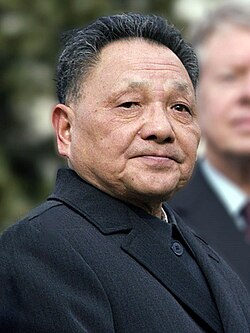
Deng Xiaoping
August 22, 1904 – February 19, 1997
Deng Xiaoping (1904–1997) was a Chinese statesman, revolutionary, and political theorist who served as the paramount leader of the People's Republic of China from 1978 to 1989. After Mao Zedong's death he consolidated power and guided China through the reform and opening-up era toward a socialist market economy. He joined the Chinese Communist Party in 1924 after studying in France and the Soviet Union.
Biography
Deng Xiaoping was born in Sichuan in 1904. He joined the communist movement while a student-worker in France, took part in the Long March, and was a political commissar in the war against Japan and the civil war.
After 1949 he rose to General Secretary of the party, but he was purged twice during the Cultural Revolution. After Mao's death in 1976 he outmanoeuvred Hua Guofeng and by 1978 was China's paramount leader, though he never held the top formal posts.
He launched "reform and opening up": farming was returned to households, special economic zones opened to foreign investment, and markets spread, which began decades of fast growth. He kept the party's monopoly of power and backed the armed suppression of the Tiananmen Square protests in 1989. He agreed the return of Hong Kong and died in 1997.
Offices held
Hua Guofeng Succeeded by
Jiang Zemin
Military service
Affiliations
Party membership
- Jan 1, 1924 – Feb 19, 1997 Communist Party of China Joined the CCP in France
- Apr 1, 1924 – Jan 1, 1927 Kuomintang


