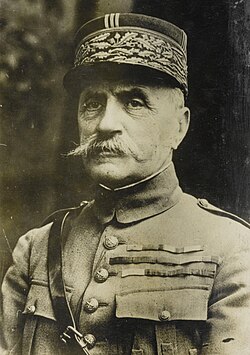
Ferdinand Foch
October 2, 1851 – March 20, 1929
Ferdinand Foch (1851-1929) was a French general, Marshal of France, and member of the Academie Francaise and Academie des Sciences. He served as Supreme Allied Commander on the Western Front during World War I in 1918.
Biography
Ferdinand Foch was born in Tarbes in 1851 into a devout Catholic family and was taught by Jesuits in Saint-Étienne and Metz. He enlisted in 1870 during the Franco-Prussian War, then entered the École Polytechnique and was commissioned in the artillery in 1873. He studied at the École supérieure de guerre from 1885, taught there from 1895 to 1901, and commanded it from 1907 to 1911, becoming known as the leading French military thinker of his generation.
In 1914 he commanded XX Corps near Nancy and then the Ninth Army at the Marne, where he won wide credit for the victory. He went on to lead the northern army group alongside the British in Flanders, Artois and the Somme, was sidelined at the end of 1916, and in 1917 became chief of the army staff.
When the German spring offensive threatened to split the Allied armies, the Doullens Conference of 26 March 1918 made him coordinator of the Allied forces on the Western Front, soon formally their commander-in-chief. He held the German advance at the Second Battle of the Marne, was made Marshal of France, and directed the counter-offensives that ended the war. On 11 November 1918 he accepted the German request for an armistice and was present at its signing.
He was elected to the Académie des sciences and the Académie française in November 1918. At the Paris Peace Conference he argued for making the Rhine Germany's western frontier and called the Treaty of Versailles far too lenient. He died in Paris in 1929 and is buried at Les Invalides.
Military service
Affiliations
Education
- Jan 1, 1871 – Jan 1, 1873 École Polytechnique École Polytechnique; commissioned in the artillery in 1873 before finishing the course
- from Jan 1, 1885 École supérieure de guerre Staff course at the École supérieure de guerre from 1885


