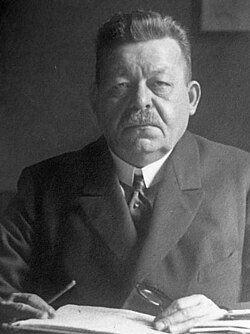
Friedrich Ebert
February 4, 1871 – February 28, 1925
First President of Germany (1919-1925); led the Council of the People's Deputies after the November Revolution
Biography
Friedrich Ebert was born in Heidelberg in 1871, the son of a tailor; his family could not afford to send him to university. He settled in Bremen in 1891, took an editorial job on the socialist Bremer Bürgerzeitung in 1893 and ran a pub that became a meeting place for socialists and trade unionists. In 1900 he became a union secretary and was elected to the Bremen city assembly for the Social Democratic Party.
In 1905 he became secretary-general of the SPD and moved to Berlin. He entered the Reichstag in 1912 and in September 1913, after August Bebel's death, was elected co-chairman of the party. During the First World War he led the SPD deputies in voting for war credits and supported the war as a defensive struggle.
On 9 November 1918, as revolution spread, Prince Max of Baden handed him the chancellorship. He then led the Council of the People's Deputies, which introduced the eight-hour day and universal suffrage, while an agreement with General Wilhelm Groener secured the army's support for the new government against the radical left. Army units and Freikorps crushed the Spartacist uprising in January 1919.
The National Assembly meeting in Weimar elected him the first president of Germany on 11 February 1919. In office he relied heavily on the emergency powers of Article 48 and faced the Kapp Putsch of 1920 and the Beer Hall Putsch of 1923. Worn down by right-wing attacks and lawsuits, he died of septic shock after appendicitis in Berlin in February 1925.
Offices held
Prince Maximilian of Baden Succeeded by
Philipp Scheidemann


