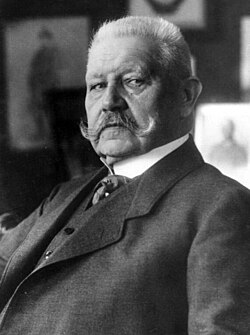
Paul von Hindenburg
October 2, 1847 – August 2, 1934
German field marshal who commanded the German army in the First World War and was President of Germany from 1925 to 1934. In 1933 he appointed Adolf Hitler chancellor.
Biography
Paul von Beneckendorff und von Hindenburg was born in Posen in 1847 into a family of minor Prussian nobility. Trained as a cadet, he joined the Third Regiment of Foot Guards and fought in the Austro-Prussian and Franco-Prussian wars. He studied at the Prussian War College from 1873, served on the General Staff and taught at the War Academy, and retired as a general in 1911.
Recalled when the First World War began, he won fame for the victory at Tannenberg in 1914 and was made field marshal and commander in the East. In August 1916 he replaced Erich von Falkenhayn as chief of the general staff; with his deputy Erich Ludendorff he exercised a near-dictatorial control over Germany's war effort until the defeat of 1918. He stepped down in 1919.
In 1925 the parties of the right persuaded him to run for president, and he won the runoff. In 1932 he was re-elected against Adolf Hitler, and that July he signed the decree by which Franz von Papen took over the government of Prussia. Though opposed to Nazism, he appointed Hitler chancellor in January 1933, a key step in the Nazi seizure of power, and then signed the Reichstag Fire Decree and the Enabling Act. He died at Neudeck in August 1934, and Hitler succeeded him as head of state with the title of Führer.
Offices held
Friedrich Ebert Succeeded by
Karl Dönitz
Military service
- Aug 22, 1914 – Sep 17, 1914 8th Army (German Empire) Commander
- Prussian Army


