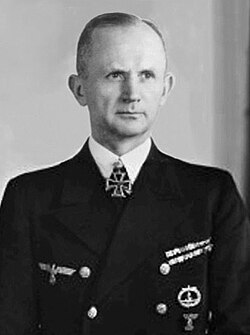
Karl Dönitz
September 16, 1891 – December 24, 1980
German grand admiral who commanded the U-boat arm and then the navy in the Second World War, and briefly succeeded Hitler as head of state in May 1945. He was later convicted at Nuremberg and served ten years in prison.
Biography
Karl Dönitz was born in Grünau near Berlin in 1891 and joined the Imperial German Navy in 1910. In the First World War he served on the cruiser Breslau in the Mediterranean and then in submarines; in 1918 he was commanding UB-68 when it was sunk and he was taken prisoner by the British. The experience led him to develop the idea of U-boats attacking convoys in coordinated groups, the later wolfpack tactic.
He stayed in the navy under the Weimar Republic and the Nazi regime and by the outbreak of the Second World War commanded Germany's U-boat arm. His submarines inflicted heavy losses on Allied shipping in the Battle of the Atlantic until the tide turned in 1943. In January 1943 he succeeded Erich Raeder as commander-in-chief of the navy with the rank of grand admiral, and he remained a committed supporter of Hitler.
Hitler's will named Dönitz head of state, and he took over on 30 April 1945. From Flensburg he sought to let as many troops and refugees as possible surrender to the Western Allies before authorising Germany's unconditional surrender in early May; the Allies arrested his government on 23 May.
Tried at Nuremberg as a major war criminal, he was convicted of crimes against peace and war crimes, largely over unrestricted submarine warfare, and served ten years in Spandau Prison. After his release in 1956 he lived at Aumühle near Hamburg, wrote his memoirs, never expressed regret for his role, and died in 1980.
Offices held
Paul von Hindenburg Succeeded by
Theodor Heuss
Military service
- Jan 1, 1910 – Jan 1, 1918 Imperial German Navy


