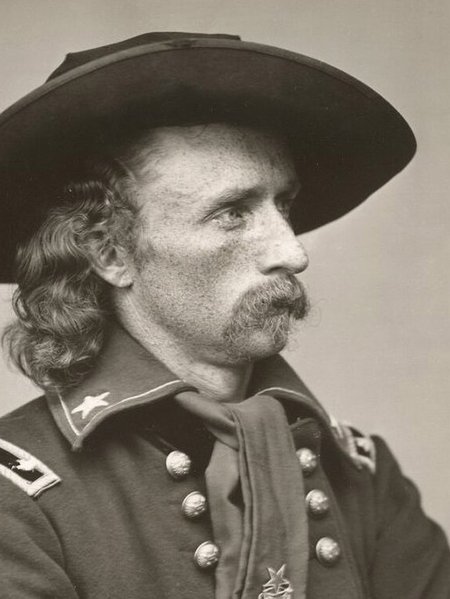
Biography
George Armstrong Custer was born in New Rumley, Ohio, in 1839, the son of a farmer and blacksmith. He graduated from McNeely Normal School in 1856, taught school in Cadiz, Ohio, and entered West Point in 1857, graduating last in his class in June 1861 as the Civil War began.
Serving on the staffs of George McClellan and Alfred Pleasonton, he was made a brigadier general of volunteers at 23 and led the Michigan cavalry brigade at Gettysburg. He fought in the Overland and Shenandoah Valley campaigns, and in April 1865 his division blocked Lee's retreat and received the first Confederate flag of truce. At 25 he became the Union's youngest major general, then commanded cavalry in occupied Texas.
In 1866 he was appointed lieutenant colonel of the new 7th Cavalry. He accompanied President Andrew Johnson on his 'Swing Around the Circle' tour, was arrested and suspended in 1867 for leaving his post without leave, and in 1868 led the attack on Black Kettle's Cheyenne camp on the Washita. In 1874 he led the Black Hills Expedition, whose announcement of gold set off the Black Hills gold rush.
In 1876 his testimony against Secretary of War William Belknap angered President Grant, who briefly kept him from the coming campaign. Restored to command under General Alfred Terry, he led the 7th Cavalry against the Lakota and Cheyenne and was killed with all the men of his five companies at the Little Bighorn on 25 June 1876.
Military service
Affiliations
Education
- Jul 1, 1857 – Jun 24, 1861 United States Military Academy United States Military Academy, West Point; graduated 34th of 34

