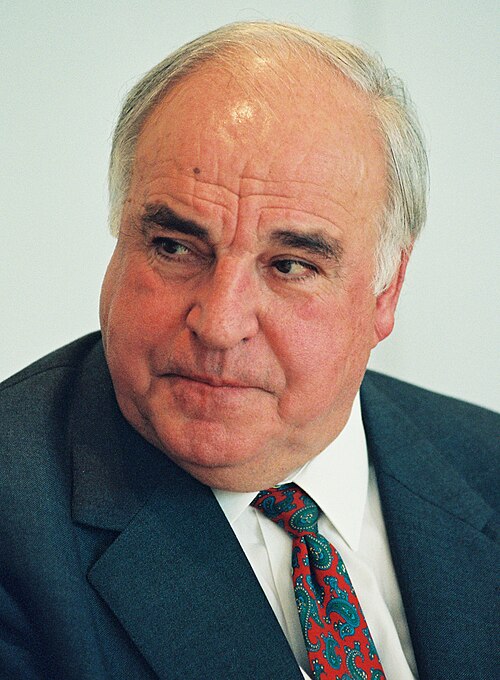
Helmut Kohl
German politician who was Chancellor from 1982 to 1998 and led the CDU from 1973 to 1998, overseeing German reunification and the creation of the European Union.
Biography
Helmut Kohl was born in Ludwigshafen in 1930 into a Catholic family and joined the newly founded CDU in 1946, at sixteen. He studied law in Frankfurt and then history and political science at Heidelberg University, where he took a doctorate in 1958. He worked as an assistant to a foundry director and from 1960 as a manager for the Industrial Union for Chemistry in Ludwigshafen.
Elected to the Rhineland-Palatinate state parliament in 1959 as its youngest member, he became minister-president of the state in 1969, regarded at the time as a progressive within his party. He was elected national chairman of the CDU in 1973, and after the 1976 federal election he moved to the Bundestag as leader of the CDU/CSU group and of the opposition.
When the Free Democrats abandoned Helmut Schmidt in 1982, Kohl became chancellor through a constructive vote of no confidence. He was a firm ally of the United States and of France; his visit with Ronald Reagan to the military cemetery at Bitburg in 1985 caused an international outcry because SS soldiers were buried there. After the fall of the Berlin Wall he moved quickly towards German unity, achieved in 1990, and with François Mitterrand he was a principal architect of the Maastricht Treaty and the euro.
Kohl was chancellor for sixteen years, the longest tenure in post-war Germany, until Gerhard Schröder succeeded him in 1998. The CDU donations scandal, which broke in 1999, led him to resign as the party's honorary chairman in 2000. He left the Bundestag in 2002 and died in Ludwigshafen in 2017.
Offices held
Helmut Schmidt Succeeded by
Gerhard Schröder
Affiliations
Education
- Jan 1, 1950 – Jan 1, 1951 Goethe University Frankfurt Two semesters of law
- Jan 1, 1951 – Jan 1, 1958 Heidelberg University History and political science; doctorate 1958


_cropped_(2).jpg)