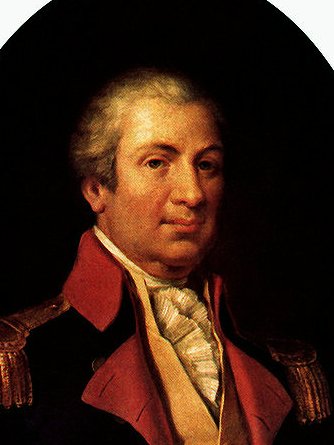
Henry Knox
July 25, 1750 – October 25, 1806
American general; chief of artillery of the Continental Army throughout the war.
Biography
Henry Knox was born in Boston in 1750 to Ulster Scots immigrants. His father's departure and death forced him to leave the Boston Latin School as a boy to work in a bookshop, and he taught himself widely, especially in military history. He joined a local artillery company, witnessed the Boston Massacre in 1770 and testified at the soldiers' trials, and in 1771 opened his own London Book Store.
When the Revolutionary War began he organised the 'noble train of artillery', hauling guns captured at Fort Ticonderoga to Boston, which helped force the British evacuation in 1776. He became the Continental Army's chief of artillery and served with Washington in all his main campaigns, from Trenton to Yorktown, set up the army's first artillery school and in 1782 became its youngest major general. In March 1783 he helped defuse the Newburgh crisis, and he wrote the founding document of the Society of the Cincinnati.
Knox led the troops who reoccupied New York in November 1783 and briefly served as the army's senior officer. In 1785 the Confederation Congress made him Secretary at War, and in 1789 Washington appointed him the first Secretary of War under the Constitution. He shaped early Indian policy, which treated the tribes as sovereign nations, signed the 1790 Treaty of New York with the Muscogee, directed the campaigns of the Northwest Indian War and pressed for the founding of a navy.
He left office at the end of 1794 and retired to Thomaston in the District of Maine, where he built the Montpelier estate and speculated in land and business ventures that left him heavily in debt. He died there in October 1806.
Offices held
Benjamin Lincoln Succeeded by
Timothy Pickering
Military service
Affiliations
Education
- Boston Latin School Pupil at the Boston Latin School; left school at about nine
Party membership
- Federalist Party Federalist (infobox)


