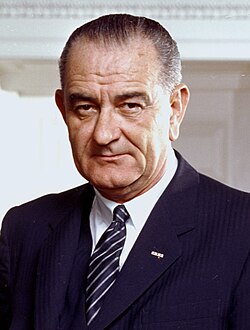
Lyndon B. Johnson
August 27, 1908 – January 22, 1973
Lyndon B. Johnson (1908-1973) was the 36th president of the United States from 1963 to 1969, assuming office after the assassination of John F. Kennedy, under whom he had served as vice president since 1961. He served in the U.S. House of Representatives from 1937 and in the U.S. Senate, where he became Senate majority leader in 1954. He won reelection in 1964 by a landslide and pursued a domestic agenda known as the Great Society.
Biography
Lyndon B. Johnson was a Texas Democrat who entered the House of Representatives in 1937 and the Senate in 1949. As Senate majority leader from 1955 he became known for his skill in pushing legislation through, including the Civil Rights Act of 1957.
He was John F. Kennedy's running mate in 1960 and became president when Kennedy was assassinated in November 1963. He won a landslide election in 1964. His Great Society program included the Civil Rights Act of 1964, the Voting Rights Act of 1965, Medicare and Medicaid, federal aid to education and the War on Poverty.
Johnson greatly expanded the American war in Vietnam after the Gulf of Tonkin Resolution of 1964. Rising casualties, the Tet Offensive and protests at home eroded his support, and in March 1968 he announced that he would not seek another term. He died at his Texas ranch in 1973.
Offices held
Richard Nixon Succeeded by
Hubert Humphrey
John F. Kennedy Succeeded by
Richard Nixon
Military service
- Jan 1, 1941 – Jan 1, 1942 United States Navy


