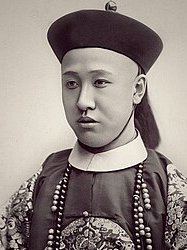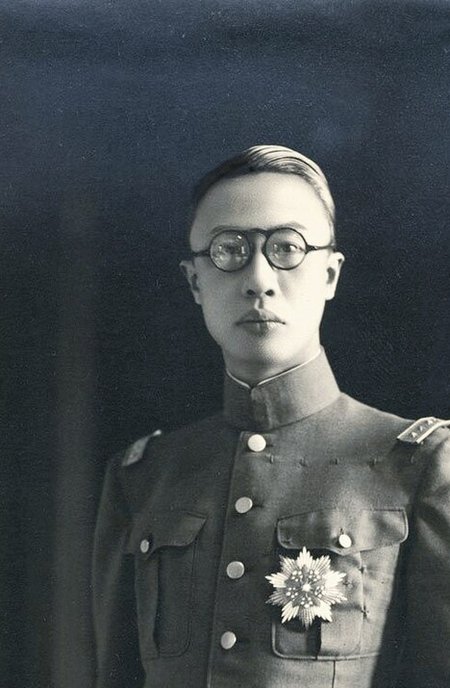
Puyi
February 7, 1906 – October 17, 1967
Last emperor of China, reigning as the Xuantong Emperor from 1908 to 1912 and briefly in 1917, and later the Japanese-installed ruler of Manchukuo. After imprisonment as a war criminal he was amnestied in 1959.
Biography
Puyi was born in Beijing in 1906 into the Qing imperial clan. In 1908 the dying Empress Dowager Cixi chose him to succeed the Guangxu Emperor, and he took the throne as the Xuantong Emperor at the age of two, with his father Prince Chun as regent. After the Xinhai Revolution the Empress Dowager Longyu issued the edict of abdication on his behalf in February 1912; under the agreed terms he kept his title and continued to live in the Forbidden City.
In July 1917 the loyalist general Zhang Xun restored him to the throne for twelve days before republican forces ended the attempt. In 1924 the warlord Feng Yuxiang expelled him from the palace, and he moved to the Japanese concession in Tianjin, where he courted warlords and Japanese officials in the hope of regaining power.
After Japan seized Manchuria, Puyi accepted Japanese sponsorship and in 1932 became chief executive of the puppet state of Manchukuo, which was declared an empire with him as the Kangde Emperor in 1934. He had little real power. Captured by Soviet forces in 1945, he testified at the Tokyo war crimes tribunal in 1946 and was handed over to the People's Republic of China in 1950, where he spent nearly a decade in a re-education prison.
Released under an amnesty in 1959, he worked as a gardener and then as a researcher at a cultural and historical institute, published a ghostwritten autobiography, and in 1964 became a member of the Chinese People's Political Consultative Conference. He died in Beijing in 1967.
Offices held
Guangxu Emperor
3 terms
- Dec 2, 1908 – Feb 12, 1912 Imperial China Preceded by Guangxu Emperor
- Jul 1, 1917 – Jul 12, 1917 Imperial China
- Mar 1, 1934 – Aug 17, 1945 Manchukuo
Affiliations
Party membership
- from Jan 1, 1960 Communist Party of China