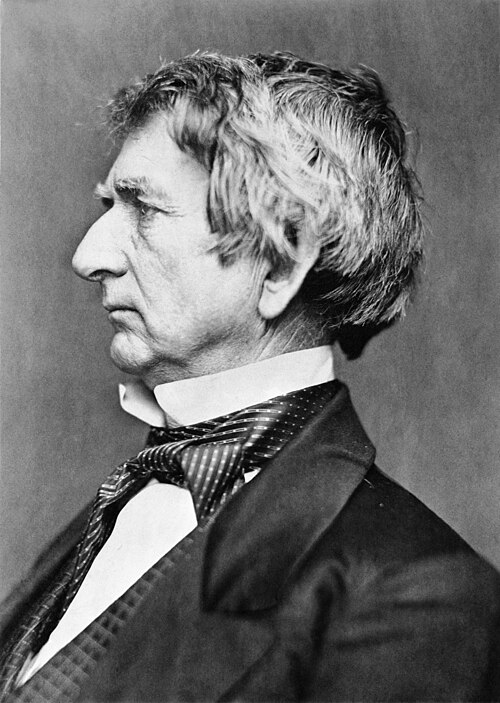
William H. Seward
May 16, 1801 – October 10, 1872
American politician who was governor of New York and a leading anti-slavery senator, then Secretary of State from 1861 to 1869, when he negotiated the Alaska Purchase.
Biography
William Henry Seward was born in 1801 in Florida, New York, the son of a prosperous landowner. He graduated from Union College in 1820, qualified as a lawyer and settled in Auburn, where his alliance with the newspaper publisher Thurlow Weed shaped his political career.
Elected to the New York State Senate as an Anti-Mason in 1830, he became a Whig and served two terms as governor from 1839 to 1842, backing laws that protected fugitive slaves and free black residents. Elected to the U.S. Senate in 1849, he became the leading anti-slavery voice there, appealing to a 'higher law' than the Constitution in 1850 and later speaking of an 'irrepressible conflict' between slave and free labour. He joined the new Republican Party in 1855.
Seward was the favourite for the Republican presidential nomination in 1860 but lost to Abraham Lincoln on the third ballot, then campaigned for him and became Secretary of State. During the Civil War he worked to keep Britain and France from recognising the Confederacy, notably by defusing the Trent Affair in 1861.
On the night of Lincoln's assassination in April 1865 he was badly wounded by Lewis Powell. He remained in office under Andrew Johnson, negotiated the purchase of Alaska from Russia in 1867, and retired in 1869. He died at Auburn in 1872.
Offices held
William L. Marcy Succeeded by
William C. Bouck
Jeremiah S. Black Succeeded by
Elihu B. Washburne
Affiliations
Party membership
- Jan 1, 1834 – Jan 1, 1855 Whig Party (United States)
- Republican Party (United States)
- Anti-Masonic Party Anti-Mason before 1834


