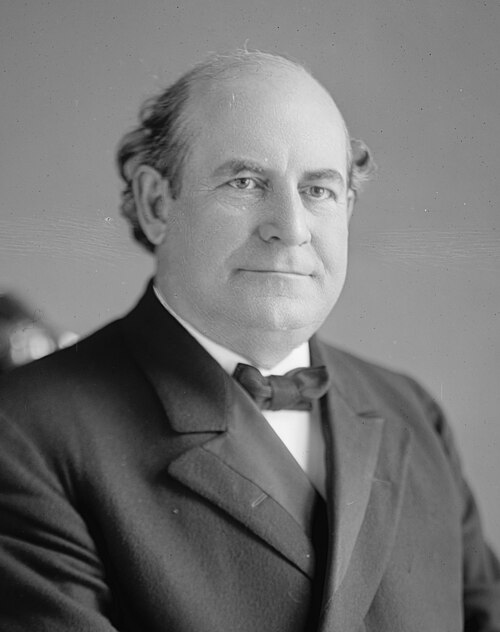
William Jennings Bryan
March 19, 1860 – July 26, 1925
American lawyer, orator and Democratic politician who was his party's presidential nominee in 1896, 1900 and 1908 and Secretary of State under Woodrow Wilson from 1913 to 1915.
Biography
William Jennings Bryan was born in Salem, Illinois, in 1860. He graduated at the top of his class from Illinois College in 1881 and from Union College of Law in Chicago in 1883, practised law in Jacksonville, and in 1887 moved to Lincoln, Nebraska.
Elected to the House of Representatives in 1890, he served two terms, championing tariff cuts, free coinage of silver and an income tax, and lost a Senate race in 1894. His Cross of Gold speech at the 1896 Democratic convention won him the presidential nomination at 36; backed also by the Populists, he lost to William McKinley. He raised a Nebraska volunteer regiment in the Spanish-American War, ran again in 1900 on an anti-imperialist platform and lost again, and lost a third time to William Howard Taft in 1908. Between campaigns he published the weekly The Commoner and lectured widely on the Chautauqua circuit.
His support helped Woodrow Wilson win the 1912 nomination, and Wilson made him Secretary of State. Bryan negotiated a series of arbitration treaties and pressed for neutrality in the First World War, resigning in June 1915 over Wilson's protest note to Germany after the sinking of the Lusitania.
In later years he campaigned for Prohibition, women's suffrage and against the teaching of evolution, settled in Miami, and in July 1925 joined the prosecution in the Scopes trial in Dayton, Tennessee. He died in Dayton five days after the trial ended.
Offices held
Philander C. Knox Succeeded by
Robert Lansing
Affiliations
Party membership
Education
- Illinois College Illinois College (BA 1881)
- Union College of Law Union College of Law, Chicago (LLB 1883), now Northwestern's law school
