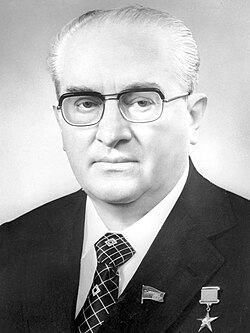
Yuri Andropov
June 15, 1914 – February 9, 1984
Yuri Andropov (1914–1984) was a Soviet politician who served as general secretary of the Communist Party of the Soviet Union from November 1982 until his death in February 1984. He had previously served as chairman of the KGB from 1967 to 1982 and as Soviet ambassador to Hungary (1954–1957), a period that included the suppression of the 1956 Hungarian Uprising.
Biography
Yuri Andropov was born in 1914 at Nagutskaya in the Stavropol region of southern Russia. He rose through the Komsomol and the Communist Party, which he joined in 1939, and during the Second World War served with the Soviet partisans.
As Soviet ambassador to Hungary from 1954 to 1957, he played a key part in crushing the 1956 Hungarian Revolution, persuading Nikita Khrushchev that military intervention was necessary. He then headed the Central Committee department for relations with ruling communist parties.
In 1967 he became chairman of the KGB and held the post for fifteen years, pressing for hard measures against the Prague Spring and suppressing dissent at home. He joined the Politburo in 1973 and, as Leonid Brezhnev declined, shaped Soviet policy with Andrei Gromyko and Dmitry Ustinov.
After Brezhnev's death in November 1982 he became general secretary, and in 1983 also chairman of the Presidium of the Supreme Soviet. He campaigned against corruption and slack labour discipline and promoted younger reformers including Mikhail Gorbachev, while Cold War tensions deepened, notably after the Soviet shootdown of Korean Air Lines Flight 007. Kidney failure left him gravely ill from early 1983, and he died in February 1984 after about fifteen months in power.
Offices held
Leonid Brezhnev Succeeded by
Konstantin Chernenko
Affiliations
Party membership
- from Jan 1, 1939 Communist Party of the Soviet Union


