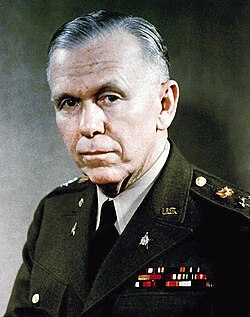
George C. Marshall
December 31, 1880 – October 16, 1959
George C. Marshall (1880-1959) was an American military officer and diplomat who became Chief of Staff of the U.S. Army under presidents Franklin D. Roosevelt and Harry S. Truman, then served as Secretary of State and Secretary of Defense under Truman. As Secretary of State he advocated the post-war European recovery program known as the Marshall Plan, for which he was awarded the Nobel Peace Prize in 1953.
Biography
George Catlett Marshall was born in Uniontown, Pennsylvania, in 1880 and graduated from the Virginia Military Institute in 1901. Commissioned in 1902, he served in the Philippines and finished first in his Army Staff College class in 1908. In the First World War he was a key planner for the American Expeditionary Forces, including the Meuse-Argonne Offensive, and he then became aide to the Army chief of staff, John J. Pershing.
Between the wars he served in China with the 15th Infantry, taught at the Army War College, and as assistant commandant of the Infantry School from 1927 modernised its methods. He became Army chief of staff in September 1939, organised the largest military expansion in American history and coordinated Allied strategy in Europe and the Pacific, earning Churchill's tribute as the organiser of victory and five-star rank.
After stepping down in 1945 he went to China as special envoy in an unsuccessful attempt to bring the Nationalists and Communists into a coalition government. As Secretary of State from 1947 to 1949 he championed the European recovery programme known as the Marshall Plan, for which he received the Nobel Peace Prize in 1953. He later headed the American Red Cross and the American Battle Monuments Commission, served a year as Secretary of Defense after the Korean War began, and died in 1959.
Offices held
Malin Craig Succeeded by
Dwight D. Eisenhower
James F. Byrnes Succeeded by
Dean Acheson
Louis A. Johnson Succeeded by
Robert A. Lovett


