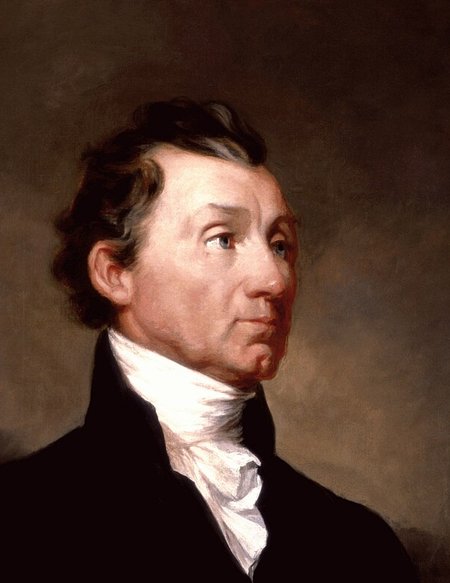
James Monroe
James Monroe was a Founding Father and the fifth president of the United States, serving from 1817 to 1825. He was the last Founding Father to serve as president and the last president of the Virginia dynasty, and his presidency coincided with the Era of Good Feelings. He issued the Monroe Doctrine, a policy aimed at limiting European colonialism in the Americas.
Biography
James Monroe fought in the Continental Army and was wounded at Trenton. He served in Congress, as a senator, as governor of Virginia and as minister to France, where he helped negotiate the Louisiana Purchase in 1803.
He was Secretary of State and Secretary of War under James Madison during the War of 1812. Elected president in 1816 and re-elected almost unopposed in 1820, he presided over the "Era of Good Feelings" after the collapse of the Federalist Party.
His presidency saw the acquisition of Florida from Spain, the Missouri Compromise of 1820 and, in 1823, the Monroe Doctrine, which warned European powers against new colonisation in the Americas. He was a slaveholder and supported the American Colonization Society; Liberia's capital, Monrovia, is named after him. He died on 4 July 1831.
Offices held
James Wood Succeeded by
Peyton Randolph (governor)
2 terms
- Dec 28, 1799 – Dec 1, 1802 Preceded by James Wood Succeeded by John Page
- Jan 16, 1811 – Apr 2, 1811 Preceded by George William Smith Succeeded by Peyton Randolph (governor)
Also Secretary of State of 2 others
- United States Oct 1, 1814 – Feb 28, 1815
- United States Feb 28, 1815 – Mar 3, 1817 Succeeded by John Graham
John Armstrong Jr. Succeeded by
William H. Crawford
James Madison Succeeded by
John Quincy Adams

