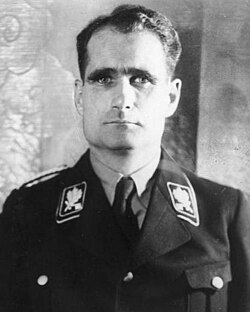
Rudolf Hess
April 26, 1894 – August 17, 1987
German Nazi politician who was Deputy Führer from 1933 until his solo flight to Scotland in 1941. He was convicted at Nuremberg and died in Spandau Prison in 1987.
Biography
Rudolf Walter Richard Hess was born in 1894 in Alexandria, Egypt, into a wealthy German merchant family. He served as an infantryman in the First World War, was wounded several times and won the Iron Cross, and left the army in 1918 as a reserve lieutenant. In 1919 he enrolled at the University of Munich, where he studied geopolitics under Karl Haushofer.
He joined the Nazi Party in 1920 and was beside Hitler during the Beer Hall Putsch of 1923. While both were imprisoned afterwards he helped Hitler with Mein Kampf, and he served as Hitler's private secretary. In April 1933 he was named Deputy Führer, and that December he joined the cabinet as minister without portfolio; he signed much of the regime's legislation, including the Nuremberg Laws of 1935.
Sidelined once the war began, on 10 May 1941 he flew alone to Scotland hoping to open peace talks through the Duke of Hamilton, and was held prisoner by the British for the rest of the war. At the Nuremberg trials he was convicted of crimes against peace and conspiracy and sentenced to life imprisonment. He served the sentence in Spandau Prison, latterly as its only inmate, and hanged himself there in 1987 at the age of 93.
Offices held
Military service
- Jan 1, 1914 – Jan 1, 1918 Imperial German Army
Affiliations
Education
- from Jan 1, 1919 LMU Munich studied geopolitics under Karl Haushofer


