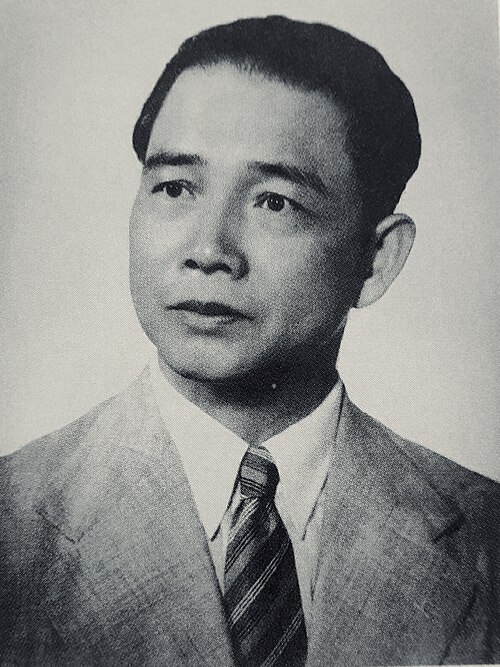
Wang Jingwei
May 4, 1883 – November 10, 1944
Chinese revolutionary and Kuomintang leader, a close follower of Sun Yat-sen, who later headed the Japanese-backed collaborationist government in Nanjing from 1940 to 1944.
Biography
Wang Zhaoming, who wrote and later lived under the pen name Wang Jingwei, was born in Sanshui, Guangdong, in 1883. After passing the county-level imperial examination he went to Japan in 1903 on a Qing scholarship to study at Hosei University. There he met Sun Yat-sen and in 1905 joined the Tongmenghui, becoming known as a polemicist for its newspaper. In 1910 he took part in a failed bomb plot against the regent Prince Chun; he was sentenced to life imprisonment but freed after the Wuchang Uprising and then helped broker the talks between Yuan Shikai and the revolutionaries that ended Qing rule.
He spent much of the 1910s in France, where he started the Work-Study Movement, before returning to Sun's circle. He served as education minister in Sun's Guangzhou government from 1921 and drafted Sun's testaments in 1925. After Sun's death he became the first chairman of the Nationalist government and leader of the Kuomintang's left wing, but lost out to Chiang Kai-shek after the 1926 Canton Coup. In 1927 he headed the rival Wuhan government, then purged its Communists in the July 15 Incident. He joined the anti-Chiang coalition defeated in the 1930 Central Plains War and was expelled from the party.
After the Japanese seizure of Manchuria he reconciled with Chiang and served as premier from 1932 to 1935, presiding over unpopular settlements with Japan such as the Tanggu Truce; he was badly wounded by a gunman in 1935. Favouring a negotiated peace once full-scale war began, he left Chongqing for Hanoi in December 1938, was expelled from the Kuomintang, and in March 1940 became head of the Japanese-sponsored Reorganized National Government in Nanjing.
His regime signed far-reaching concessions to Japan, declared war on Britain and the United States in 1943 and recovered the foreign concessions in occupied cities. He died in Nagoya in November 1944 while being treated for his old wound. Condemned as a traitor by both Nationalists and Communists, he was also a respected classical poet, and some later scholarship has reassessed his record.
Offices held
Zhang Zuolin Succeeded by
Chiang Kai-shek
Affiliations
Education
- from Jan 1, 1903 Hosei University Studied at Hosei University on a Qing government scholarship from 1903
Party membership
- from Jan 1, 1905 Tongmenghui
- Nov 28, 1939 – Nov 10, 1944 Kuomintang (Wang Jingwei) Kuomintang-Nanjing, the ruling party of the Wang Jingwei regime, which he founded and chaired
- Kuomintang


